
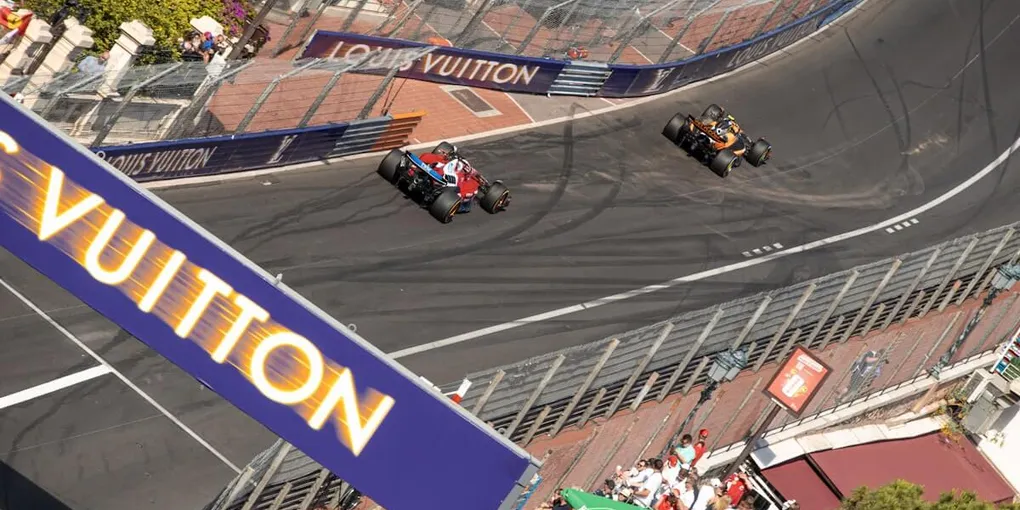

Motorsport isn’t one thing. The three biggest FIA World Championships — Formula 1, the World Endurance Championship, and the World Rally Championship — might as well be different sports.
Formula 1: The Sprint
Philosophy: Maximum performance over minimum time.
| Aspect | F1 |
|---|---|
| Race length | ~300 km (~90 min) |
| Surface | Purpose-built circuits |
| Cars | Open-wheel, hybrid V6 turbo, ~1,000 hp |
| Key skill | Consistency at the limit, tire management |
| Pit stops | ~2.0 seconds |
F1 is about extracting every thousandth of a second. Aero is king — dirty air makes overtaking hard. The cars are the fastest circuit racers on Earth, capable of pulling over 5G through high-speed corners. Drivers train like fighter pilots because the physical demands are comparable: neck muscles must support the equivalent of an extra 30 kg of helmet weight through every corner. A single lock-up, one missed braking point, and the race is over — there is no recovery from a mistake in a 90-minute sprint where the field is covered by less than two seconds.
The engineering is unrestrained within the rules. Teams spend $150 million per year developing cars that are rebuilt between every session. Every component is a consumable. An F1 power unit costs over $10 million to develop and makes over 1,000 horsepower from 1.6 liters. It is the most thermally efficient internal combustion engine ever built, and it will be obsolete in two seasons.
WEC: The Marathon
Philosophy: Reliability + speed over hours.
| Aspect | WEC (Hypercar) |
|---|---|
| Race length | 6h, 8h, or 24h |
| Surface | Circuits, some with public-road sections |
| Cars | Closed-cockpit, hybrid, ~680 hp (BoP-limited) |
| Key skill | Traffic management, night driving, fuel saving |
| Pit stops | Driver changes, tire changes, refueling |
The 24 Hours of Le Mans is the crown jewel. Cars share the track across multiple classes — Hypercars weaving through GT3 traffic at 2 AM in the rain. Winning means the car survives. The driver who sets the fastest individual lap is largely irrelevant. The driver who can run consistent laps for two hours at 3 AM, in traffic, while conserving fuel and managing tire wear, is the driver who wins the race.
Endurance racing adds a dimension that sprint racing cannot: resource management across time horizons. Fuel, tires, brakes, driver energy, and mechanical sympathy are all finite. A Hypercar pushed to 100% for the first six hours will almost certainly not finish the last six. Strategy — when to push, when to conserve, when to gamble on weather — is as important as pace. The best endurance drivers are metronomes: lap after lap within half a second, for hours, with no mistakes. Speed is not enough. Speed plus consistency plus patience wins Le Mans.
WRC: The Wild Card
Philosophy: Adapt to anything.
| Aspect | WRC (Rally1) |
|---|---|
| Race length | 3-day events, 300+ km of stages |
| Surface | Gravel, tarmac, snow, ice — sometimes all in one rally |
| Cars | Hatchback-based, hybrid turbo, ~500 hp |
| Key skill | Trusting pace notes, car control on loose surfaces |
| Pit stops | Service parks between stages, not during |
WRC drivers are a different breed. They thread 500 hp hatchbacks between trees on gravel roads they have only seen twice during recce, guided entirely by a co-driver’s voice. No practice laps. No runoff areas. No gravel traps. Just commitment.
The surface changes every stage, sometimes every corner. A single rally might run on dry tarmac in the morning, muddy gravel by midday, and ice by evening. The car setup is a compromise — you cannot optimize for everything, so you optimize for nothing and rely on the driver to adapt. This is why rally drivers are considered the most versatile in motorsport: they are the only ones who must be fast on surfaces they cannot practice on, guided by notes they wrote at road-legal speeds.
Which is hardest?
They’re hard in different ways:
- F1 demands physical endurance (5G cornering) and surgical precision. One tenth per lap over 50 laps wins races. The physical training is the most intense in motorsport.
- WEC demands mental endurance and teamwork. Three drivers sharing one car, negotiating traffic across multiple classes, through day and night. The race doesn’t stop for mistakes — it just compounds them.
- WRC demands raw car control and absolute trust. No second chances. No runoffs. One mistake and you’re in the trees. The co-driver relationship is unique in sport — two people must communicate with perfect clarity at 200 km/h through a language they invented together during recce.
Watch all three. The drivers who excel in one discipline rarely dominate the others, which tells you everything about how specialized the skills are — a nine-time WRC champion was competitive but not dominant in World RX, and an F1 world champion found the Indy 500 harder than anything he had ever attempted in a Formula car.
Related: Focused on rally? See how WRC stacks up against Rallycross — same surface, completely different sport. And for the cars that made WRC legendary, check out the greatest rally cars of all time. For the engineering behind all three disciplines, dive into how F1 power units work. And for the human side of F1, read about the Senna vs Prost rivalry.