

Rally cars are different. They don’t race on sanitized circuits with runoff areas and gravel traps. They fly through forests at 120 mph with trees six inches from the door. The cars that excel in this environment aren’t just fast — they’re tough, communicative, and capable of surviving punishment that would destroy anything else. Here are the legends.
Lancia Stratos HF (1974–1978)
The first car purpose-built for rallying from the ground up. Mid-engined, powered by a Ferrari Dino V6, and styled by Bertone with a wedge shape that looked like it was doing 100 mph standing still. The Stratos won the WRC manufacturers’ title three years running (1974–1976). It was also notoriously evil to drive — short wheelbase, snap oversteer, and zero forgiveness. But in the right hands, it was untouchable.
Why it matters: The Stratos proved that a bespoke rally car beat converted road cars every time.
Audi Quattro (1981–1986)
All-wheel drive wasn’t new in 1980, but Audi was the first to make it work in rallying at the highest level. The Quattro’s turbocharged inline-five and AWD system rewrote the rulebook — while everyone else was fighting for traction with two driven wheels, the Audi just hooked up and went. It won two manufacturers’ and two drivers’ titles, and the Quattro S1 E2 remains one of the most iconic Group B cars ever built.
Why it matters: AWD is now standard in rallying because Audi proved it was unbeatable.
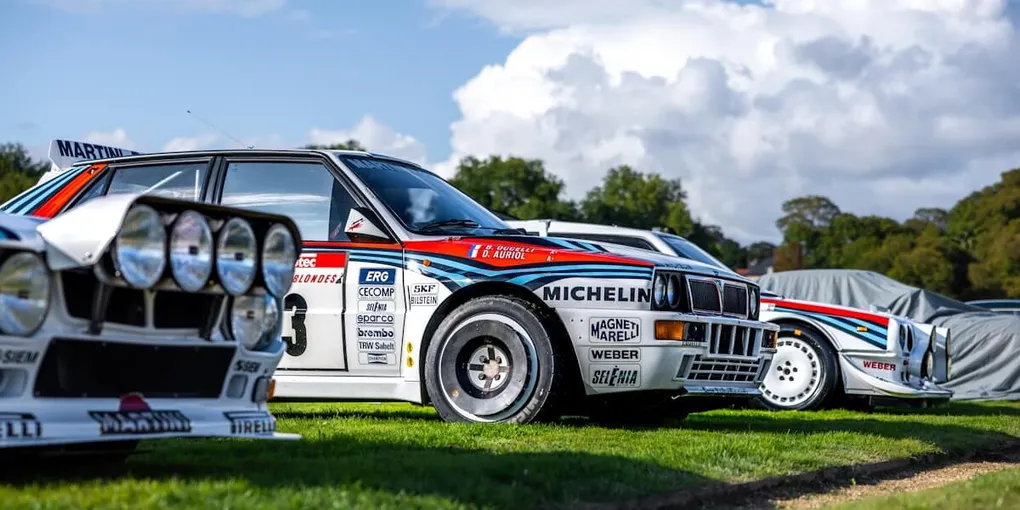
Lancia Delta Integrale (1987–1992)
After Group B was banned in 1986, rallying moved to Group A — production-based cars with limits on power and modifications. Lancia responded with the Delta Integrale, and proceeded to win six consecutive manufacturers’ championships. Six. The Integrale took a humble hatchback platform and turned it into a turbocharged, AWD monster with flared arches and Martini livery that’s still replicated on tuner cars today.
Why it matters: The most dominant single model in WRC history.
Subaru Impreza WRX STI (1993–2008)
The blue car with gold wheels. The boxer rumble. Colin McRae throwing it sideways through every corner whether he needed to or not. The Impreza won three manufacturers’ titles and three drivers’ titles with McRae, Richard Burns, and Petter Solberg. It became a cultural phenomenon — suddenly everyone wanted a turbocharged, AWD sedan with a hood scoop.
Why it matters: The Impreza democratized rally performance. You could actually buy one.
Mitsubishi Lancer Evolution (1992–2007)
The Evo was the Impreza’s eternal rival — and for Tommi Mäkinen, it was the weapon of choice for four straight drivers’ championships (1996–1999). The Evo’s active yaw control and brutally effective powertrain made it a giant-killer on every surface. The Evo VI Tommi Mäkinen Edition is a holy-grail car to this day.
Why it matters: The Evo vs. STI rivalry pushed both cars to incredible heights — and gave us the greatest automotive feud since Ford vs. Ferrari.
Toyota Celica GT-Four (1988–1999)
Before Toyota dominated the 1990s WRC, the ST185 and ST205 Celica GT-Four were the cars that got them there. Carlos Sainz won the 1992 drivers’ title, and the ST205 was so dominant in 1995 that Toyota got caught with an illegal turbo restrictor — resulting in a rare 12-month ban from the WRC.
Why it matters: The “cheating Celica” scandal is one of WRC’s most infamous moments — and the ST205 remains a cult hero.
Ford Escort RS (1968–1997)
The original Mk1 and Mk2 Escorts — rear-wheel-drive, lightweight, and blessed with a chassis that thrived on abuse — won the RAC Rally eight times and the manufacturers’ title in 1979. These cars weren’t high-tech. They were simple, oversteer-happy, and driven by absolute madmen. Björn Waldegård, Ari Vatanen, and Hannu Mikkola all cut their teeth in Escorts.
Why it matters: The Escort represents rallying’s purest era — before computers, before AWD, when talent was the only traction control.
Honorable Mentions
- Peugeot 205 T16: Group B insanity with a mid-mounted turbo four and 450+ horsepower.
- Citroën C4 WRC: Sébastien Loeb’s weapon for four straight titles. Arguably the most effective WRC car ever.
- Mini Cooper S: The little car that won the Monte Carlo Rally three times in the 1960s, proving weight matters more than power.
What connects all of these cars is not horsepower or technology — it is the fact that each one was driven to victory by someone who trusted it completely at speeds that would terrify most people on a highway, let alone a gravel road lined with trees. The greatest rally cars are the ones that made their drivers feel invincible, even when physics suggested otherwise.
Related: WRC is just one flavor of rally — here’s the difference between WRC and Rallycross, and how F1 vs WEC vs WRC compare as the three pillars of top-tier motorsport. For how rally drivers navigate these cars, read pacenotes decoded. And for the wildest era in rally history, see Group B: the machines that were too fast to race.
Rally cars aren’t museum pieces. They’re survivors. The best ones carry scars, stories, and the DNA of drivers who trusted them at triple-digit speeds through the dark, in the rain, on the limit. These are the cars that earned that trust.