
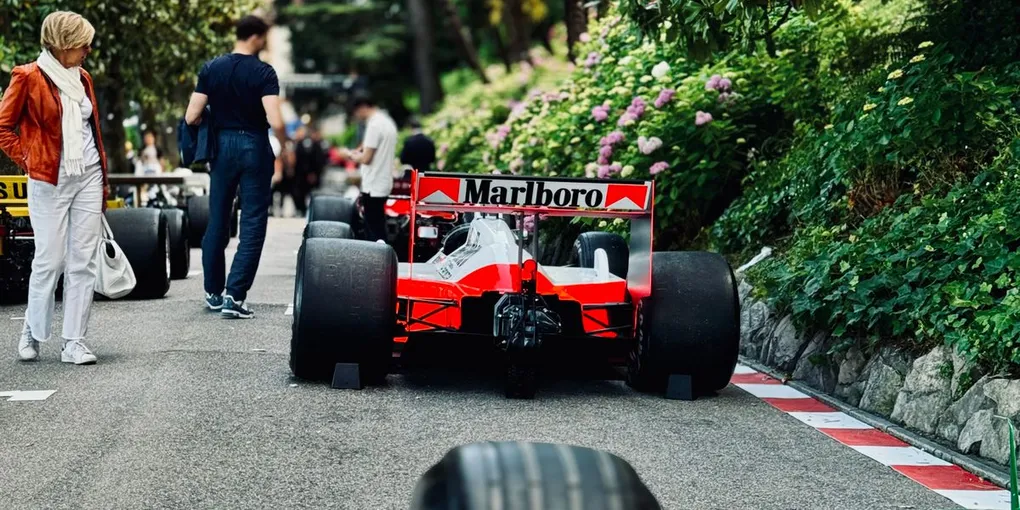

Every great rivalry in sport is built on contrast, and no motorsport rivalry was built on more contrast than Ayrton Senna and Alain Prost. Senna was instinct, aggression, raw speed that seemed to come from somewhere beyond talent. Prost was calculation, precision, a metronomic consistency that drained the life out of his opponents. Both drove for McLaren. Both wanted to win more than they wanted to be teammates. And for five seasons — 1988 through 1993 — their war defined Formula 1.
1988: The Dominance Begins
McLaren-Honda MP4/4. The most dominant car in F1 history. It won 15 of 16 races in 1988. Fifteen of sixteen. Senna took eight wins and the championship. Prost took seven wins. The only race McLaren lost was Monza, where Senna crashed while lapping a backmarker with two laps to go.
The season established the dynamic that would define the rivalry: Senna, slightly faster over one lap, extracting more from the car in qualifying — he outqualified Prost 13 to 3. Prost, the better strategist over a race distance, managing tires and fuel with an intuition no telemetry could replicate. Both brilliant. Neither willing to concede an inch.
The Portuguese Grand Prix that year was the warning shot. Senna squeezed Prost toward the pit wall at 280 km/h on the start-finish straight. Prost held his line, kept his foot down, and won the race. Afterward, he said the move was deliberate. Senna said it was not. The fracture was now visible.
1989: The Breaking Point
Suzuka, Japan. The penultimate race. Prost leads the championship. Senna must win to stay alive. On lap 46, Senna dives inside Prost at the chicane. Prost turns in — earlier than normal, some say deliberately — and the two McLarens collide. Prost is out. Senna restarts, cuts the chicane, wins the race.
The stewards disqualify Senna for cutting the chicane. Prost is champion. Senna calls it a conspiracy orchestrated by FISA president Jean-Marie Balestre. The FIA suspends Senna’s super license. The relationship, already broken, becomes nuclear.
1990: Revenge
Suzuka again. Senna on pole, but the pole position is on the dirty side of the grid. Senna asks for it to be moved; the request is denied. Prost, now at Ferrari, starts second on the clean side.
At the start, Prost gets a better launch and pulls alongside. Senna, in the McLaren, keeps his foot down. The cars collide at 270 km/h at the first corner. Both are out. Senna is world champion — the points gap means Prost cannot catch him regardless. Senna later admits the collision was deliberate. “I told myself, whatever happens, I’m going to make the corner first. He was not going to make it before me.”
Two championships decided by collisions at the same corner, in the same race, two years apart. It is either the most poetic or the most cynical thing that ever happened in F1, depending on your perspective.
The Reconciliation
They never raced as teammates again. Prost retired after winning the 1993 championship with Williams. Senna moved to Williams in 1994. Before the season started, Prost, now a TV commentator, interviewed Senna at Imola. It was reportedly a warm exchange — two rivals, older and wiser, acknowledging that what had passed between them was born of a shared obsession.
Three months later, Senna was dead. At his funeral, Prost was a pallbearer. He later said, “When he died, part of me died too.”
Why It Endures
The Senna-Prost rivalry endures because it was about more than racing. It was about two fundamentally different ways of being — the artist and the scientist, faith and reason, passion and calculation. Neither was wrong. Neither was entirely right. Together, they pushed each other to heights neither would have reached alone.
The 1988-1990 McLaren era remains the gold standard for intra-team rivalry, and no pairing since — not Hamilton-Rosberg, not Vettel-Leclerc, not Verstappen-Ricciardo — has captured the same mix of brilliance, bitterness, and mutual respect that Senna and Prost achieved.
What made their rivalry different from every team battle since was the philosophical depth of the conflict. Hamilton and Rosberg fought over a championship. Senna and Prost fought over what racing was.
- Senna believed speed came from God — a gift, not a skill, something you accessed through faith and commitment. When he drove, he talked about out-of-body experiences, seeing corners before they existed, channeling something beyond himself.
- Prost believed speed came from intelligence — data, analysis, conservation of equipment. He calculated tire degradation curves in his head and adjusted his pace to match. He won races on Saturday night in the engineering meetings.
They were not just rivals. They were incompatible worldviews sharing a garage and a stopwatch.
In their final years, the animosity softened. Prost attended Senna’s funeral as a pallbearer and later became a trustee of the Senna Foundation, which supports underprivileged children in Brazil. When asked about Prost years after the rivalry, Senna admitted: “I miss him. I miss the competition.” The rivalry that defined F1 was also, in its own way, the most honest relationship either man ever had in the sport.
The Senna-Prost rivalry endures because it transcends sport. It is a story about two men who brought out the absolute best and absolute worst in each other, who could not coexist and could not stay apart, whose mutual obsession produced the greatest era in Formula 1 history. You do not need to be an F1 fan to understand it. You just need to have wanted something badly enough to fight for it. Senna and Prost fought. And the sport is richer for every scar they left on each other.
Related: For more on F1 engineering, read how F1 power units work. For how F1 compares to other top-tier racing, see F1 vs WEC vs WRC.