
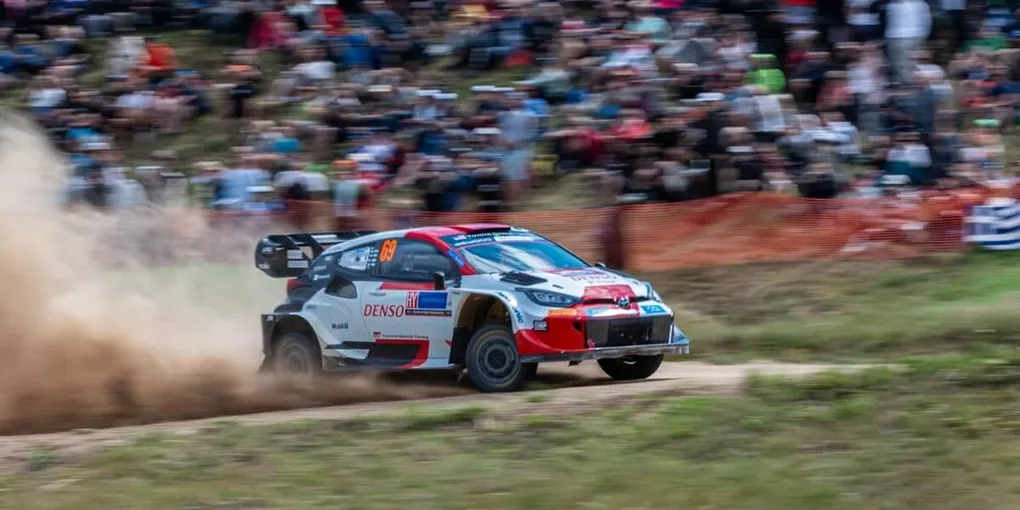

You’re watching sideways cars kick up rooster tails of gravel — and honestly, it’s easy to mix them up if you don’t know what to look for, and someone asks: “Is this WRC or Rallycross?” If you hesitated, don’t worry — you’re not alone. They share DNA, but the actual sports are night-and-day different. Let’s settle this.
WRC: The Marathon of Madness
The World Rally Championship is the pinnacle of stage rally. Drivers and co-drivers tackle closed public roads — tarmac, gravel, snow, you name it — in timed stages that can be 15–30+ kilometers long. It’s just you, your pace notes, and a road you’ve never driven at speed before.
Key WRC traits:
- Stages run one car at a time — it’s a time trial, not wheel-to-wheel racing.
- Events span 3–4 days with 15–25 stages across hundreds of kilometers.
- Co-drivers are essential — they read pace notes describing every corner before the driver can see it.
- Real roads, real consequences — trees, cliffs, and stone walls line the stages. There are no runoff areas.
- Service parks between groups of stages let teams repair and tune the cars.
WRC is endurance, precision, and bravery blended into the most demanding motorsport on earth. One mistake in a 30-kilometer stage and your rally is over.
Rallycross: The Sprint of Insanity
Rallycross (or World RX at the top level) takes the same cars — or similar ones — and throws them onto a short, mixed-surface circuit for wheel-to-wheel combat.
Key Rallycross traits:
- Head-to-head racing — 4–6 cars on track at the same time, banging doors.
- Short laps — circuits are usually 1–1.5 km, mixing tarmac and dirt, lasting about 4–6 minutes per heat.
- Joker laps — every driver must take one alternate (usually longer) route per race, adding a strategic element.
- No pace notes, no co-driver — the driver knows every corner by heart after practice.
- Standalone events — heats, semi-finals, and a final all happen in a single day at one venue.
Rallycross is WRC’s rowdy younger sibling — louder, shorter, and designed to keep the crowd on their feet from start to finish. The cars reflect this philosophy: while WRC Rally1 cars are built for endurance across three-day events with strict technical regulations, World RX cars are optimized for five-minute bursts of wheel-to-wheel combat. Rallycross cars run similar power levels but with shorter gearing for explosive acceleration out of tight corners, aggressive anti-lag systems that keep the turbo spooled at all times, and suspension tuned for the mixed surfaces they encounter on every lap — jumping from tarmac to gravel and back again in the space of a single corner. The engines are rebuilt far less frequently than their WRC counterparts because the total running time per event is measured in minutes, not hours. This makes rallycross more accessible to privateer teams while still producing some of the most spectacular racing in motorsport.
The Quick Comparison
| Aspect | WRC | Rallycross |
|---|---|---|
| Format | Time trial, one car at a time | Wheel-to-wheel, 4–6 cars |
| Stage length | 15–30+ km | ~1–1.5 km laps |
| Event duration | 3–4 days | Single day |
| Co-driver | Yes, with pace notes | No |
| Surface | Varies per event | Mixed tarmac/dirt per lap |
| Spectator vibe | Find a spot in the forest, wait for cars to fly by | See the whole track from the grandstand |
Which One Should You Watch?
Watch WRC if you want to see the highest level of car control on the planet, cars threading through forests at 120 mph with nothing but faith in their co-driver’s notes.
Watch Rallycross if you want door-handle-to-door-handle racing with jumps, dirt, and the kind of chaos that makes every heat unpredictable.
Or do what I do: watch both. They scratch completely different itches.
The Crossover Drivers Who Prove Both Are Legit
The best evidence that WRC and Rallycross demand fundamentally different skills is how rarely drivers excel at both. Sebastien Loeb — nine WRC titles — tried World RX and was competitive but not dominant. Petter Solberg won world championships in both disciplines, making him the rare exception that proves the rule. The transition requires rewiring everything: from managing a 30-kilometer stage alone to reading traffic and joker strategies in a four-lap sprint. The cars are similar. The mindset is not.
If you want to understand rally as a sport, watch both. WRC shows you the art of commitment. Rallycross shows you the chaos of competition. One is a poem. The other is a bar fight. Both are worth your time.
WRC and Rallycross are not competitors for your attention — they are two ways of watching the same fundamental talent express itself in different formats. WRC is poetry at 120 mph through a Finnish forest. Rallycross is a bar fight in a phone booth with four other drivers who all want the same apex. Watch both. The drivers who excel at one invariably respect the other, because they know how hard both are. The surface may change, but the commitment required is exactly the same.
Related: For the bigger picture, see how F1 vs WEC vs WRC compare across all three top-tier disciplines. For the machines that defined the sport, don’t miss the greatest rally cars of all time. And for the system that makes rally navigation possible, check out pacenotes decoded.
The two disciplines feed each other in ways that are not obvious from the outside. Many rally drivers credit rallycross with sharpening their car control in traffic, while rallycross drivers say stage rally experience gives them an edge in reading grip on mixed surfaces. They are not competitors — they are complementary expressions of the same fundamental skill: controlling a car at the limit on surfaces that do not want to cooperate. If you love one, you owe it to yourself to try the other.