
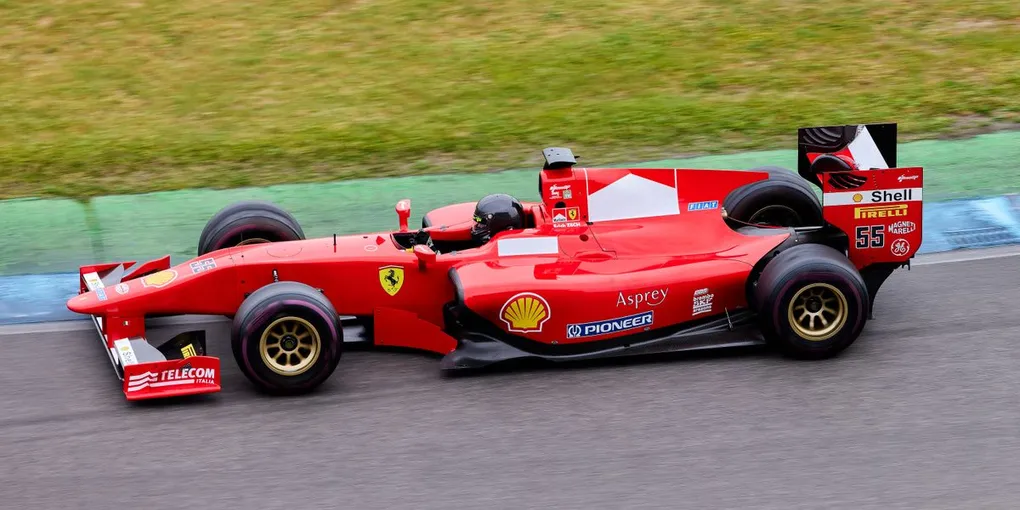

The modern Formula 1 power unit is the most thermally efficient internal combustion engine ever built by human beings. Not hyperbole — a road car engine converts about 25-30% of its fuel’s energy into motion. The current F1 power unit hits over 50%. That number alone should tell you something extraordinary is happening under the engine cover.
Not Just an Engine — a Power Unit
Since 2014, F1 hasn’t used the word “engine” in the technical regulations. They’re called power units, and the distinction matters. A power unit has six components:
- Internal Combustion Engine (ICE) — the 1.6-liter V6 turbo
- Motor Generator Unit–Kinetic (MGU-K) — harvests energy from braking
- Motor Generator Unit–Heat (MGU-H) — harvests energy from exhaust heat
- Turbocharger — shared shaft with the MGU-H
- Energy Store (ES) — the battery
- Control Electronics (CE) — the brain
It is a hybrid system, but not the kind you find in a Prius. This is not about fuel economy. It is about extracting every possible joule from a fixed fuel flow rate.
The V6 at the Core
The ICE is a 1.6-liter 90-degree V6 with a single turbocharger. The displacement is small because the fuel flow limit is capped at 100 kg/hour — there is no point in a larger engine because you cannot feed it. The bore is fixed at 80 mm, the stroke at 53 mm. These are undersquare engines that spin to 15,000 rpm, though the fuel flow limit means they rarely exceed 12,000 in a race.
Direct injection at up to 500 bar, pre-chamber ignition (a small chamber above the main combustion chamber that shoots jets of flame into the cylinder), and lean-burn operation all contribute to that 50% efficiency figure. Ferrari, Mercedes, Honda, and Renault each spend hundreds of millions developing these engines, and the differences between them — when they exist — are measured in single-digit horsepower.
MGU-K: Regenerative Braking, F1 Style
The MGU-K is connected to the crankshaft and does two things. Under braking, it acts as a generator — converting the car’s kinetic energy into electricity and storing it in the battery. Under acceleration, it acts as a motor — deploying that stored energy to the rear wheels at up to 120 kW (161 hp).
Road car hybrids do this too, but at dramatically lower power levels. The MGU-K can recover up to 2 MJ of energy per lap and deploy the full 120 kW for about 33 seconds per lap. Drivers manage deployment strategically — save energy through a slow section, deploy it all on the next straight, repeat.
MGU-H: The Genius Nobody Talks About
The MGU-H might be the single cleverest piece of engineering in modern motorsport. It sits on the shaft connecting the turbine and compressor of the turbocharger.
Here is the problem it solves: turbochargers have lag. You put your foot down, exhaust gases spin the turbine, the turbine spins the compressor, the compressor forces air into the engine, and eventually you get boost. In 2014, without the MGU-H, F1 cars would have had enormous turbo lag. The racing would have been terrible.
The MGU-H solves this in two directions. As a generator, it harvests excess exhaust energy — slowing the turbine to prevent overboost and sending electricity to the battery. As a motor, it spools up the turbo before the exhaust gases arrive — eliminating lag. When you hear a driver lift and coast into a corner in an F1 car, the MGU-H is still spinning the turbo at 100,000 rpm, keeping the boost ready for the exit.
The MGU-H is also the reason F1 power units are so efficient. It recovers energy from heat that would otherwise be wasted out the exhaust — energy no road car captures in any meaningful way.
The 2026 Regulation Change
The MGU-H is being dropped for 2026. The new power units will keep the V6 turbo but replace the MGU-H with a more powerful MGU-K (350 kW instead of 120 kW). The reasoning: the MGU-H is astronomically expensive to develop, and its road relevance is essentially zero. No road car uses exhaust heat recovery at this scale because it requires a turbine spinning at 100,000 rpm sitting next to a 900-degree exhaust manifold.
The 2026 engines also switch to fully sustainable fuel. Combined with the increased electrical power, F1 will be closer to a 50/50 split between combustion and electric power — a true hybrid in the modern sense.
Why It Matters
F1 power units are not just racing toys. The pre-chamber ignition technology developed for F1 is appearing in road cars — Maserati’s Nettuno engine uses it. The lean-burn combustion strategies influence production engine design. And the shift to sustainable fuels in 2026 will accelerate development of fuels that can power existing cars without the carbon cost of burning fossil fuel.
Fifty percent thermal efficiency from a 1.6-liter engine sounds impossible. It is not. It is the result of a decade of development, tens of billions of dollars, and engineering that borders on art.
Related: For a comparison across racing categories, see F1 vs WEC vs WRC: which is the ultimate test of engineering. For the driver-level technique that makes F1 cars fast, see trail braking explained.