
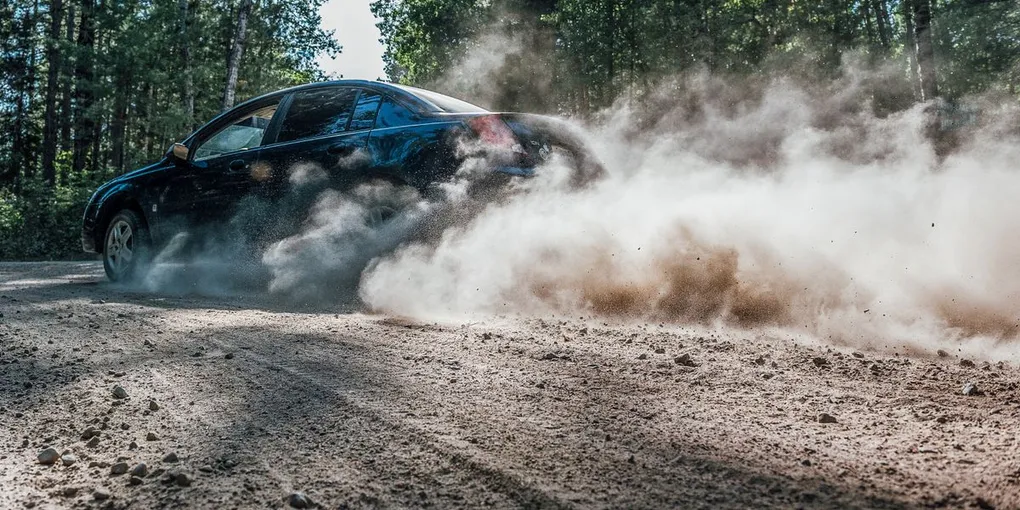

A World Rally Car crests a blind brow at 180 km/h. The driver cannot see the road ahead — the car is in the air. As it lands, the co-driver, eyes locked on a notebook, delivers the next line with the same cadence as the last hundred: “Right five tightens, keep in over crest, left four opens, one hundred.”
The driver turns the wheel before seeing the corner. The car slots through.
This is rally pacenotes — one of motorsport’s most misunderstood skills. The driver gets the glory, but without the co-driver’s pacenotes, they would be navigating a public road at triple-digit speeds with no idea what comes next. The co-driver is not a passenger reading a map. They are the driver’s eyes into the future.
How Pacenotes Work
Pacenotes are a shorthand language describing every corner, crest, jump, and hazard on a rally stage. Teams write them during reconnaissance — or “recce” — when they drive the stage at road-legal speeds, two passes maximum. The driver calls out what they see; the co-driver records it in their own notation.
The standard system uses numbers for corner severity: one is the tightest, six is flat-out. A “right five” is a fast right-hand bend. “Left two tightens” means a sharp left that gets even sharper. Modifiers add detail: “don’t cut” warns of a rock on the inside, “over crest” means the road drops away after the corner, “into” means the next corner follows immediately.
The co-driver’s delivery is everything. Too fast and the driver cannot process it. Too slow and the car arrives before the information does. Too monotone and the driver tunes out. The best co-drivers — think Daniel Elena alongside Sebastien Loeb, or Luis Moya next to Carlos Sainz Sr. — develop a rhythm that becomes part of the driver’s subconscious. The notes blur into the car’s motion.
Notation Systems
Not all pacenotes are created equal. The two dominant systems are the descriptive system and the numeric system.
The descriptive system, used by many British and Irish crews, describes corners in words: “fast right over crest, tightens.” No numbers. It relies on the co-driver’s judgment of what “fast” means relative to the car and conditions.
The numeric system, popularized by Scandinavian and continental European crews, assigns numbers to everything. A “right five” is unambiguous — it means a specific radius and speed regardless of who is driving.
Some crews use hybrids. The legendary Colin McRae and Derek Ringer used a mix — numbers for severity, words for everything else. Nicky Grist, who replaced Ringer, brought a more structured numeric system to McRae’s car, and their results improved.
The Evolution of Pacenotes
Before pacenotes, rally drivers navigated by road book alone — a list of tulip diagrams showing junctions and distances, published by the organizers. Drivers had never seen the stages before the rally started. They arrived at corners blind, relying on memory, instinct, and the co-driver’s ability to read the road book fast enough.
The shift to full pacenotes — where crews write their own notes during recce — was gradual. It began in the 1970s with crews who realized that driving the stage slowly before the rally gave them an enormous advantage. By the 1980s, pacenotes were standard at the top level. Today, modern WRC events allow only two recce passes. The crew that extracts the most from those two passes — the most detail, the most trust — has an edge before the first stage begins.
The French crew of Sebastien Loeb and Daniel Elena took this to an extreme. Loeb’s pacenotes were famously fast — so fast that commentators listening to the in-car audio would lose track of where the car was on the stage. Elena delivered notes at a pace no other co-driver matched, and Loeb processed them all. Nine world championships later, the system had proven itself.
Why the Relationship Matters
A bad pacenote is worse than no note. If the co-driver says “right four” and it is actually a “right two,” the driver has already committed at the entry speed for a faster corner. Trust erodes. The driver starts backing off, hesitating, losing rhythm.
The best pairings develop such deep trust that the driver never questions a note. When Timo Rautiainen read notes for Marcus Gronholm, Gronholm once said he did not remember the stages — he just drove what Timo told him. That is the ideal: the driver focuses entirely on execution, and the co-driver carries the mental map.
Rally is chaos — changing surfaces, weather, grip, visibility. But a great set of pacenotes shares three qualities:
- Consistency: The same corner always gets the same number. The driver builds muscle memory across stages and seasons. A right-four in Finland should mean the same thing as a right-four in Portugal.
- Brevity: Every syllable counts when you are covering 150 meters per second. The co-driver has roughly the time between corners to deliver the next call. Extra words get cut. Adjectives earn their place.
- Trust: The driver must never second-guess a call. The moment hesitation enters the relationship, lap times suffer. The best co-drivers are invisible — their voice is simply the voice of the road.
Pacenotes are the one constant. The co-driver’s voice in the driver’s ear is the anchor point around which everything else rotates. Without it, a rally car is just a fast car on a road it does not know.
Related: For more on rally cars and their engineering, see the greatest rally cars of all time. For a comparison of WRC with other rally formats, read what’s the difference between WRC and Rallycross.