
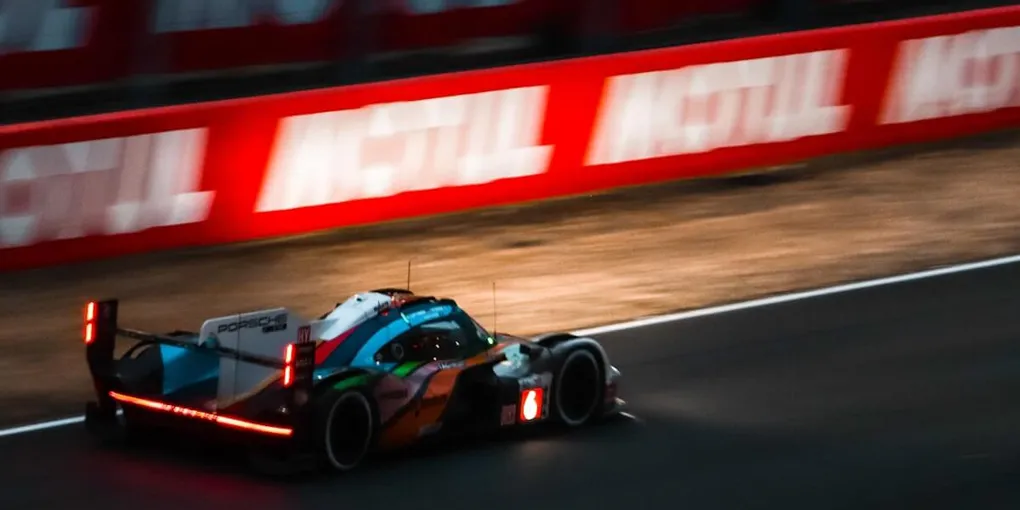

Le Mans isn’t just a race. It’s a test of engineering, a war of attrition, and the only sporting event where watching the sunrise genuinely feels like a spiritual experience. Every June, 60+ cars line up in rural France and race for 24 hours straight. The winner isn’t the fastest car — it’s the car that’s fast and still running when the clock hits zero.
The Format
Three classes share the track simultaneously:
- Hypercar — the top class. Toyota, Ferrari, Porsche, Cadillac, Peugeot, and (soon) Aston Martin build bespoke prototypes with hybrid systems. These are the cars fighting for overall victory. The class replaced the wildly expensive LMP1 formula in 2021 and has been an unqualified success — grids are deeper, racing is closer, and manufacturer interest is higher than at any point since the late 1990s.
- LMP2 — spec prototypes with a single engine supplier (Gibson V8). The drivers’ class — identical cars, pure talent. LMP2 is where future stars are developed and where gentleman drivers rub shoulders with factory pros.
- LMGT3 — production-based GT cars (replacing GTE in 2024). Ferrari 296, Porsche 911, Corvette Z06, Aston Martin Vantage. These are the cars you can actually buy, turned up to racing spec. The class runs on the same Balance of Performance system that makes GT3 racing so competitive globally.
Three drivers per car, rotating through stints of 1-2 hours. That’s 8+ hours of driving per person, through day, night, rain, and the mental fog of 4 AM. Drivers sleep in shifts — maybe two or three hours total over the entire event — and wake up to climb straight back into a car doing 340 km/h on the Mulsanne.
The Strategy
Endurance racing adds a dimension that sprint racing doesn’t: resource management. Fuel, tires, brakes, driver energy, and mechanical sympathy are all finite resources consumed at different rates. A car pushed to 100% for the first six hours will almost certainly not finish the last six. The winning strategy is rarely the fastest strategy — it’s the one that minimizes total pit stop time while keeping the car healthy enough to push when it matters.
Weather adds chaos. Le Mans has seen everything from blistering heat to biblical downpours. The 2024 race saw rain so heavy that the safety car ran for hours. A car optimized for dry conditions can be undrivable in the wet, and vice versa. Teams monitor radar constantly, trying to predict when to switch tires or adjust aero balance.
The Moments That Define It
Le Mans history is built on moments:
- 1955 — the worst disaster in motorsport history, when a car flew into the crowd, killing over 80 spectators. The tragedy reshaped racing safety worldwide and led to bans on motorsport in several countries.
- 1966-69 — Ford vs Ferrari, the GT40’s four-peat, immortalized in film. A corporate grudge match that produced one of the most beautiful cars ever built.
- 1970 — Porsche’s first overall win, the start of a record 19 victories that no other manufacturer has approached.
- 1991 — Mazda’s rotary-powered 787B becomes the only Japanese car (and only rotary) to win overall. The engine was so loud that noise regulations were rewritten the following year.
- 1999 — Mercedes’ CLRs literally backflip on the Mulsanne due to an aero flaw, ending their Le Mans program overnight. Mark Webber was driving one of them.
- 2018 — Alonso wins with Toyota, completing two-thirds of motorsport’s Triple Crown (Monaco GP, Le Mans, Indy 500). He would later attempt the Indy 500 multiple times, and the fact that even a two-time F1 champion found it the hardest of the three tells you everything about how difficult each leg is.
How to Watch
The full 24 hours streams on the WEC app and Eurosport. But the real magic is the atmosphere — 250,000+ fans camping trackside, the Ferris wheel lit up, and the distant scream of prototypes echoing through the French countryside at 3 AM. The start — where drivers sprint across the track to their cars — is one of the few remaining traditions from the event’s original 1923 format. It is also objectively ridiculous, and that is exactly why it survives.
Le Mans is the only race where failure is not just expected but inevitable. Something will break. The weather will turn. A driver will make a mistake at 3 AM. The car that wins is never the fastest car on the grid — it is the one that managed its failures best. That is the lesson Le Mans teaches, and it is why the race resonates far beyond motorsport. Endurance is not about avoiding problems. It is about solving them faster than they accumulate.
Related: F1 vs WEC vs WRC compares the three pillars of top-tier motorsport. For production-based racing that shares DNA with LMGT3, see GT3 racing explained. And for a look inside what makes a GT3 car tick, check out inside a GT3 race car.