

Group B only existed for four years. In that time, it produced cars so fast that the World Rally Championship became the most popular motorsport on the planet — and so dangerous that it killed drivers, co-drivers, and spectators. When the FIA pulled the plug at the end of 1986, Group B left behind a legacy that still defines what “extreme” means in rallying.
The Formula
The Group B regulations, introduced in 1982, were almost comically permissive. To homologate a car, a manufacturer needed to build 200 road-going examples — half the 400 required by the old Group 4 rules. There were almost no restrictions on engine configuration, drivetrain layout, materials, or aerodynamics. Minimum weight was set at 960 kg for naturally aspirated engines and 1,040 kg for forced induction, but most cars came in well under.
The result was a technological explosion. Mid-engine, all-wheel-drive platforms using spaceframe chassis and composite body panels. Engines producing 500-600 horsepower in qualifying trim, sometimes more. Cars that could accelerate from 0-100 km/h on gravel faster than most sports cars could manage on asphalt.
The grid, by 1985, was absurd. Peugeot 205 T16. Lancia Delta S4. Audi Sport Quattro S1. Ford RS200. Metro 6R4. All of them mid-engine, all-wheel-drive monsters with power-to-weight ratios that rivaled contemporary F1 cars — while racing on public roads lined with spectators.
The Cars
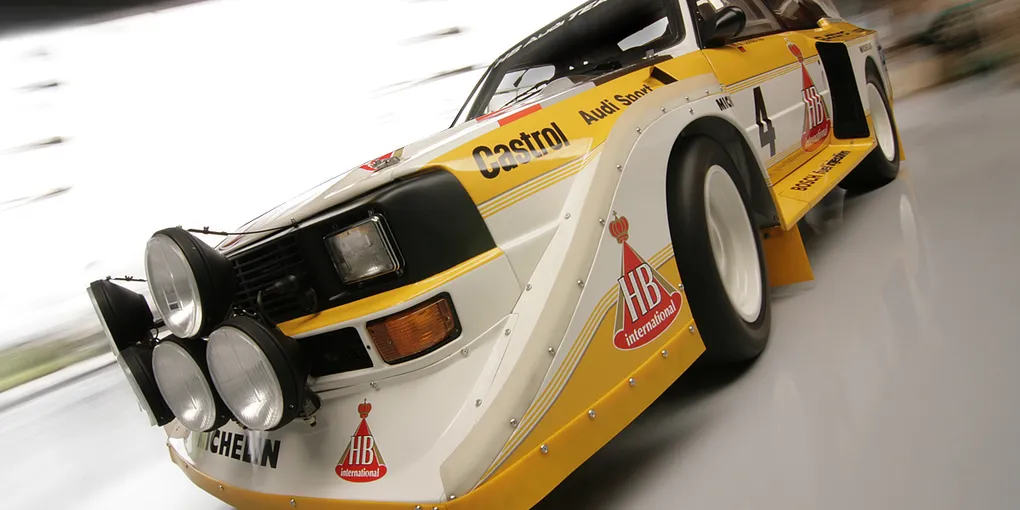
The Audi Sport Quattro S1 was the pioneer. Audi had been the first to make all-wheel-drive work in rallying with the original Quattro in 1980, and the S1 — with its shortened wheelbase, 600 horsepower, and aero package that included a rear wing large enough to double as a dining table — was the culmination. It sounded like nothing else: a five-cylinder turbo that warbled and spat flames on the overrun.
The Peugeot 205 T16 was the disruptor. Mid-engined, spaceframe chassis, Kevlar body panels. Where the Audi used a longitudinal engine ahead of the front axle, Peugeot put its 1.8-liter turbo behind the driver. The car was balanced, precise, and in the hands of Ari Vatanen and Timo Salonen, dominant. Peugeot won the manufacturers’ title in 1985 and 1986.
The Lancia Delta S4 was the technological peak. It was both supercharged and turbocharged — a small supercharger eliminated lag at low RPM, and a large turbo took over at high RPM. The system, called “twin-charging,” gave the Delta S4 a powerband that stretched from idle to 8,000 RPM without a single flat spot. At the 1986 Rally Portugal, Markku Alen’s Delta S4 was reportedly producing over 600 horsepower. On gravel.
The Ford RS200 was the evolution car that arrived too late. Designed from scratch as a Group B car — unlike the others, which were based on production models — the RS200 had a carbon-Kevlar body, a mid-mounted 1.8-liter turbo producing 450 hp in race trim, and fully independent double-wishbone suspension. It was monstrously fast but unproven. Three crashes during the 1986 Rally Portugal — one involving a spectator — sealed its fate before it could establish itself.
The End
May 2, 1986. The Tour de Corse. Lancia’s Henri Toivonen and his co-driver Sergio Cresto were leading the rally. On stage 18, their Delta S4 left the road on a left-hand bend, plunged down a ravine, and caught fire. Both men died instantly. Toivonen was 29.
Toivonen’s crash was the catalyst, but it was not the only tragedy of the Group B era. Attilio Bettega died in his Lancia 037 at the 1985 Tour de Corse. Multiple spectators were killed at Rally Portugal in 1986 when Joaquim Santos’ RS200 left the road. The cars had outrun the safety infrastructure. The roads were too narrow, the crowds too close, the speeds too high for any margin of error.
The FIA announced the end of Group B at the end of 1986. From 1987, the top class would be Group A — production-based cars with limited modifications, lower power, and actual safety standards.
The Legacy
Group B was unsustainable. Everyone involved knew it at the time. But that is not why it is remembered. It is remembered because for four years, the rulebook got out of the way and let engineers build the fastest rally cars the world had ever seen. The footage from that era — Audi Quattros spitting fire through Finnish forests, Peugeot 205 T16s dancing sideways on Greek gravel, Lancia Delta S4s screaming up Alpine passes — remains the most spectacular footage in motorsport history.
Every rally car built since lives in Group B’s shadow. None have matched it — not because the engineers forgot how to build fast cars, but because the regulations that replaced Group B were specifically designed to prevent exactly what made it great:
- Power was capped at around 300 hp, down from the 500-600 hp Group B cars were making by 1986.
- Weight was raised to slow the cars down and improve safety margins.
- Aero was restricted — no more dining-table wings, no more ground-effect tunnels, no more active aero.
- Production requirements returned — manufacturers had to build road-going versions again, ending the era of pure homologation specials.
The cars that followed were safer, slower, and more sensible. None ever will match the spectacle of Group B — and that may be for the best.
Related: For the cars that came after, see the greatest rally cars of all time. For the navigation system that makes rally possible, read pacenotes decoded.
Cover photo: Audi Sport Quattro S1 E2 by Michael Heimrich, CC BY-SA 2.0, via Wikimedia Commons