
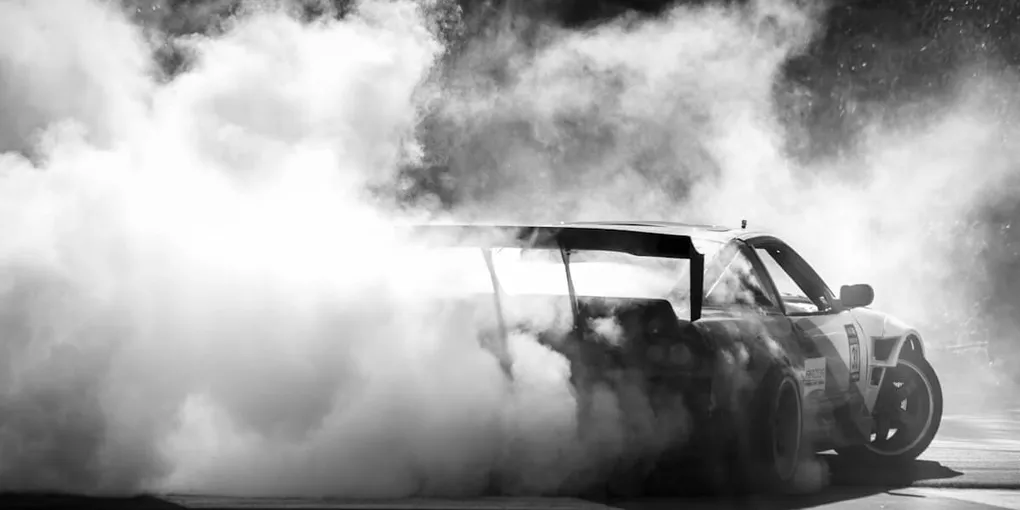

Drifting looks like chaos. It’s actually physics — predictable, repeatable, and engineered down to the tire compound. The car is sliding, but the driver is in control. Here’s what’s actually happening at the mechanical level.
The Slip Angle Sweet Spot
Every tire has a slip angle — the difference between where the wheel is pointed and where the car is actually going. In normal driving, slip angles are tiny (1-3°). In drifting, they’re massive (30-60°).
The key is staying in the tire’s “friction circle” — the maximum grip available in any direction. Imagine a circle whose radius represents the tire’s maximum grip. The tire can use all of that grip for cornering, all for braking, or any combination in between. A drifting tire is operating at the edge of that circle: most of its grip is spent laterally (keeping the car sliding sideways) while the remainder is split between longitudinal grip (acceleration/deceleration).
This is why drifting is not just spinning tires — it’s balancing the car precisely at the edge of a physics envelope that changes with every degree of slip angle, every degree of tire temperature, and every percent of throttle input. The driver is solving a differential equation in real time using their right foot and their hands.
Weight Transfer Is Everything
Drifting isn’t about horsepower — it’s about weight transfer. Initiating a drift requires shifting weight off the rear tires:
- Clutch kick: Dumping the clutch sends a shock of torque to the rear wheels, breaking traction instantly. The sudden torque spike overwhelms the tire’s grip before it can build a friction reaction. This is the most common technique in competition because it’s fast and predictable.
- Scandinavian flick: A rapid weight transfer — steer away from the corner, then sharply into it. The pendulum effect unloads the rear. This is the rally driver’s initiation and works brilliantly on low-grip surfaces or in low-power cars.
- Handbrake: Locks the rear wheels briefly, initiating the slide. Common in FWD drifting and low-power cars. The handbrake bypasses the engine entirely — it mechanically forces the rear to slide. The downside is speed loss; the rear tires stop rotating, scrubbing momentum.
- Power over: The brute-force method — enough throttle to overwhelm rear grip mid-corner. Only works with sufficient power, but when it works, it’s the smoothest and fastest initiation because it doesn’t interrupt the car’s momentum.
Sustaining the Drift
Once sideways, the driver modulates three things simultaneously:
- Throttle — controls wheel speed and angle. More throttle = more wheel spin = more smoke and angle. Less throttle = car straightens out. The relationship is nonlinear — at extreme angles, adding throttle can actually reduce angle by pushing the car forward instead of sideways.
- Counter-steering — the front wheels point where you want to go, not where the car is angled. This is why drift cars run massive steering angle kits (60°+ of lock). Without sufficient angle, the car “drives off” the counter-steering and spins out.
- Left-foot braking — used mid-drift to transfer weight forward, adjusting front grip without lifting off the throttle. This is how drivers fine-tune their line through a corner without sacrificing speed or angle.
The simultaneous control of three independent inputs, each affecting the car in a different way, at speeds of 100+ km/h, with the rear tires on fire — this is why competitive drifting is a genuine athletic skill. It is not a party trick. It is a motor control problem of staggering complexity that must be solved faster than conscious thought allows.
The Differential’s Role
A welded or aggressively locking differential is critical. An open diff sends power to the wheel with least resistance (the inside wheel, which has no load). A locked diff forces both rear wheels to spin at the same speed, keeping the slide consistent. The moment both rear tires break traction together — rather than one spinning uselessly while the other grips — is the moment a drift transitions from an accidental slide into a controlled maneuver. Without a locking differential, drifting is nearly impossible — the car will one-wheel-peel out of every slide, losing momentum and angle simultaneously.
Drifting occupies a strange space in motorsport — it is simultaneously the most accessible discipline to try and the hardest to master. Anyone with a rear-wheel-drive car and an empty parking lot can initiate a slide. Sustaining it, linking it to the next corner, doing it in tandem with another car inches away, and doing it consistently enough to win a judged competition — that takes years. The physics are simple enough to explain in a single article. The execution is complex enough to consume a lifetime.
Related: For more on how differentials work, read our deep dive on open, LSD, and locking diffs. For the competitive side of drifting, here’s Formula Drift explained. To build your own drift machine, see building a competitive drift car. And for how drifting came to be, read from touge to Tokyo.