
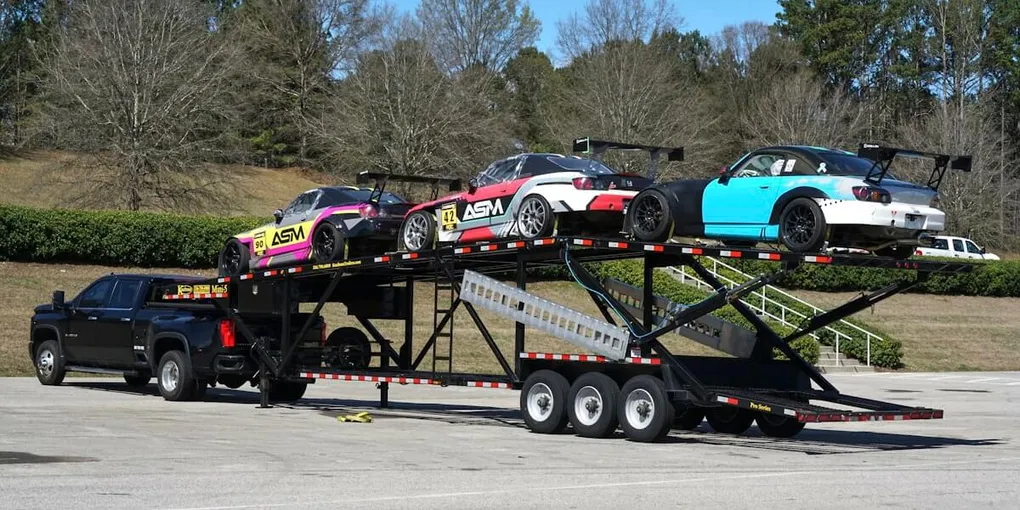

Time attack strips motorsport to its essence. No rolling starts. No tire management over a full stint. No defending position or planning overtakes. Just one car, an empty track, and the goal every driver understands instinctively: go faster.
The Format
A typical time attack event runs in sessions. Cars are classed by modification level (street, modified, unlimited), and each driver gets multiple attempts to set their fastest single lap. The clock starts when you cross the timing beam and stops when you come back around. That’s it.
What makes it uniquely demanding: the tire window. Unlike a 20-lap race where you can work up to pace, in time attack you have roughly one to two laps where the tires are at peak temperature and grip. A lap on cold tires is completely different from a lap on hot tires. The first flyer scrubs in the surface and brings heat into the carcass. If you push too hard on that lap, the car is slow. The second lap is the golden window — the tires are at temperature but not yet overheating. The third lap is already past peak. Miss your window and you’re waiting for the next session, sometimes an hour or more later.
This creates a mental pressure that circuit racing doesn’t. In a race, you have laps to recover from a mistake. In time attack, one dropped wheel, one misjudged braking point, or one poorly timed traffic encounter on your out lap, and the session is wasted. You spend the next hour staring at the timing screen, replaying the mistake in your head.
The Classes
- Street Class — registered, road-legal cars with minimal mods. Tires have a minimum treadwear rating (usually 200TW or higher). The entry point. Any enthusiast with a daily driver can compete.
- Modified/Club Class — stripped interiors, aero kits, semi-slicks (100TW or lower). Where most serious amateurs land. A well-driven Club class car can embarrass much more expensive machinery.
- Pro/Unlimited Class — full tube-frame chassis, 1,000+ horsepower, aero packages that wouldn’t look out of place on a GT3 car. These machines hold outright track records at circuits worldwide. The front splitters extend feet beyond the bumper. The rear wings could double as park benches. At 200 km/h, they generate more downforce than the car weighs.
The Iconic Cars
Japan’s time attack scene produced legends. The HKS CT230R Evo (the “Unicorn”) — a Mitsubishi Evo VIII that dominated Tsukuba for nearly a decade. The Voltex Evo IX — the car that finally beat it. The Escort Racing S2000 with its screaming naturally aspirated F20C pushing well past 300 horsepower. And at the absolute peak: the Suzuki-powered, 1,100-hp S15 Silvia that held Tsukuba’s outright record, piloted by Nobuteru Taniguchi in a car so violently fast that watching the onboard footage makes your neck hurt.
In the US, the Pike’s Peak-adjacent builds and Global Time Attack series push the envelope stateside. GTA’s Limited and Unlimited classes at events like Super Lap Battle draw entries from professional race teams. In Australia, World Time Attack Challenge at Sydney Motorsport Park is the sport’s annual gathering of the fastest tin-tops on Earth. The Pro Class cars at WTAC turn laps faster than GT3 machinery on the same circuit — and they do it with one lap, not a stint.
Why It Matters for Regular Drivers
Time attack teaches something invaluable: consistency. Stringing together a perfect lap forces you to understand corner sequences, weight transfer, and the racing line at a level that track days rarely demand. You become your own data analyst — comparing sector times, studying video, finding the tenth you left in Turn 7. It’s the gateway drug to competitive driving, and the barrier to entry is a helmet and a track day registration.
Time attack rewards a specific kind of obsession — the willingness to chase hundredths of a second through setup changes that no spectator will ever notice. A half-degree of rear wing angle. One click of rear compression damping. Two psi less in the left-front tire. None of these changes are visible from the outside. All of them show up on the stopwatch. That is the appeal. Time attack strips away everything that is not about going faster, and what remains is the purest expresion of what makes motorsport compelling: the pursuit of a perfect lap that, by definition, can never be perfect.
Time attack is motorsport reduced to its purest form. No excuses, no traffic, no team orders. Just you, the car, and a clock that does not lie. Whether you are competing at a national level or just timing your own laps at a track day, the mentality is the same: find the limit, touch it, and come back. That is what makes it addictive. Every session is a new chance to be faster than you were last time, and the only person you are racing is your previous self.
Related: Mastering the perfect racing line is step one for time attack. For the ultimate hill climb — time attack’s mountain cousin — read about Pikes Peak and hill climb racing.