
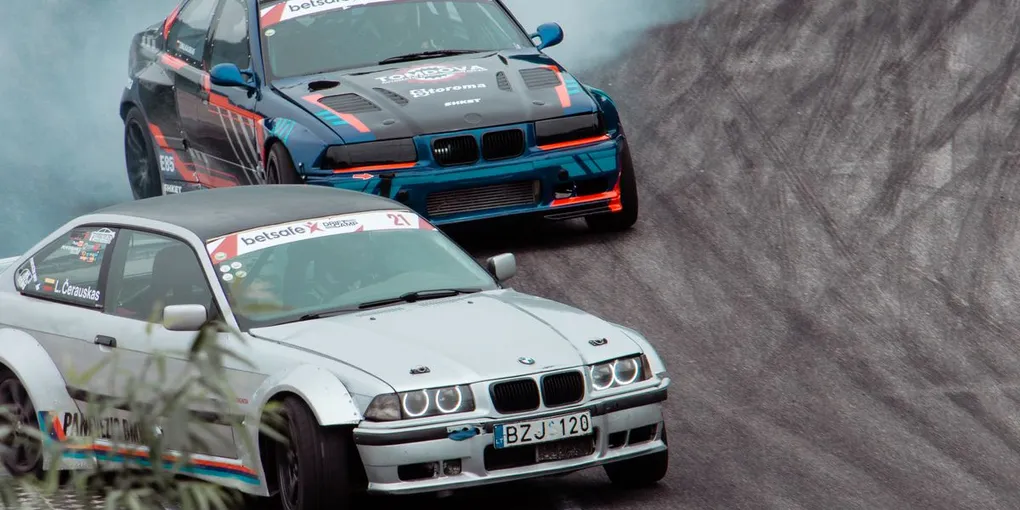

Drifting sits at an odd intersection in car culture. To casual observers, it looks like hooliganism — tires smoking, cars sideways, noise and chaos. To the people who build competitive drift cars, it is a specialized engineering discipline with unique demands that no other motorsport shares.
A drift car needs to hold extreme slip angles — sometimes exceeding 60 degrees — while maintaining enough forward bite to carry speed through a corner. It needs to transition from one direction to the other instantly. It needs to do this run after run, tire set after tire set, without breaking. Here is what that takes.
Steering Angle
The single most important modification on any drift car is steering angle. A stock car might have 30-35 degrees of lock. A competitive drift car needs 60-70 degrees — more than double. Without it, the car spins out the moment the rear steps beyond what the front wheels can catch.
Angle kits replace the steering knuckles, tie rods, and sometimes the lower control arms. They extend the steering arm geometry to increase lock while maintaining proper Ackermann — the difference in angle between the inside and outside front wheels during a turn. Too little Ackermann and the car understeers at full lock. Too much and it scrubs speed. The best kits are adjustable, letting drivers tune Ackermann to their driving style and the specific track layout.
Wisefab, Parts Shop MAX, and SerialNine are the names to know. A full angle kit with supporting suspension arms runs $1,500 to $3,500 depending on the chassis.
Suspension
Drift suspension runs counter to grip driving in several ways. Where a track car wants compliance to keep tires in contact with the road, a drift car often runs stiffer — especially at the rear — to make the car more predictable at the limit. A soft rear end loads up unpredictably mid-slide; a stiff rear behaves consistently across the weight transfer range.
Front camber is aggressive, typically negative four to six degrees. At full opposite lock — where the steering wheel is turned all the way into the slide — the outside front tire gains positive camber due to caster. The negative static camber compensates, keeping the contact patch flat when it matters most.
Rear toe is usually zero or slight toe-in. Toe-out at the rear makes the car unpredictable on transition. Zero toe gives the driver full control over when and how the rear steps out.
Coilover choice depends on budget and chassis. BC Racing, Fortune Auto, and Feal are common in grassroots builds. At the pro level — Formula Drift — teams run three-way or four-way adjustable dampers from KW, Ohlins, or Bilstein, with spring rates often exceeding 16 kg/mm at the front and 12 kg/mm at the rear.
The Differential
A welded differential is the simplest, cheapest, and most common solution. It locks both rear wheels together permanently, guaranteeing both wheels spin at the same speed — exactly what you want for consistent slides. The downside: low-speed maneuvering is miserable, tire wear is brutal, and on the street, it chirps and skips through every parking lot turn.
A two-way limited-slip differential is the upgrade. It locks under both acceleration and deceleration, giving the welded-diff behavior while drifting but allowing differential action during low-speed turning. Kaaz, OS Giken, and Cusco dominate the market. Expect to pay $800-1,500 plus installation.
At the top of the pyramid sits the spool — a solid replacement for the differential carrier that eliminates all differential action. Formula Drift cars use these exclusively. They are indestructible, completely predictable, and utterly unusable on the street.
Cooling and Reliability
Drifting destroys cars. Constant high-RPM operation, limited airflow (the car is sideways, not moving forward through clean air), and massive heat soak from tire smoke push cooling systems to their limit. Here’s what needs attention:
- Radiator: Upgraded from stock is mandatory. A 3-core aluminum radiator is the minimum for any car seeing sustained drift use.
- Oil cooler: Strongly recommended. Oil temperatures can spike 40 degrees above normal in a single run. Without a thermostatic cooler, oil viscosity drops and bearing protection disappears within the first minute of a hard session.
- Power steering cooler: Often overlooked and frequently the first thing to fail. When the fluid overheats and boils, the steering gets heavy at the exact moment the driver needs quick opposite lock — usually mid-drift, which is the worst possible time to lose assist.
Tires are a consumable. A single competition weekend can go through six to eight sets of rear tires. At $400-600 per set for decent rubber, tire cost alone can exceed the purchase price of the car within a season.
Why It Is Worth It
Drifting gets dismissed as a sideshow — an exhibition, not a sport. Spend an afternoon at a Formula Drift event and the engineering on display tells a different story. These are serious machines built to a serious purpose. The fact that the purpose involves tire smoke and 60-degree slip angles does not make the engineering any less real.
Related: For the physics that make drifting possible, read how drifting works and the science of sustained oversteer. For the competitive side of the sport, see Formula Drift explained.