
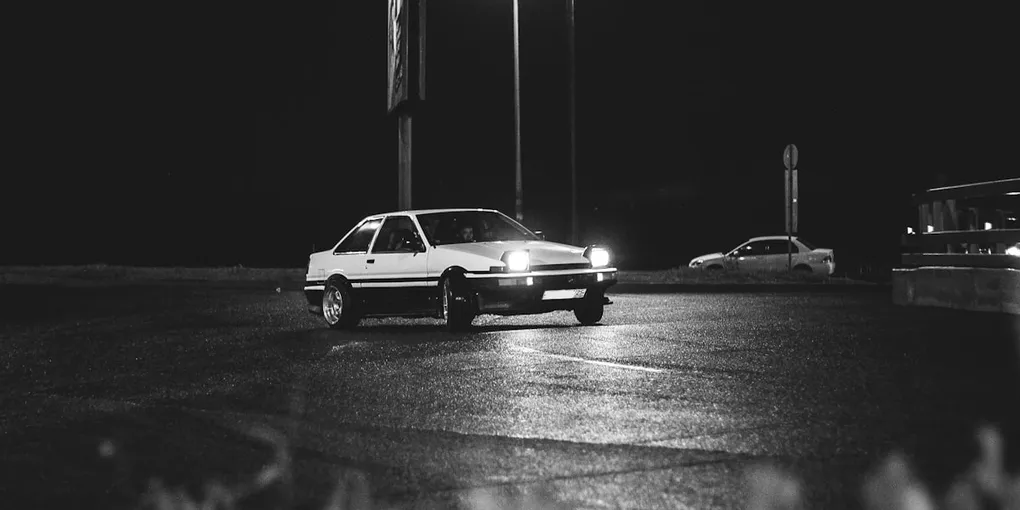

Drifting did not start in a stadium with judges and angle sensors. It started on mountain roads in the dead of night, with kids in borrowed cars pushing the limits of grip just to see what would happen. The touge — the winding mountain passes that connect Japan’s rural towns — was the original arena. What happened there, over three decades, transformed into a global motorsport worth millions.
The Touge
Japanese mountain roads are carved into geography that does not cooperate. Tight hairpins linked by short straights, blind crests dropping into off-camber corners, guardrails that are more suggestion than protection. The roads were never built for speed. That, of course, made them perfect for it.
In the 1970s and 80s, groups of young drivers — the hashiriya, or street racers — began gathering on these passes late at night. Traffic was minimal. Police presence was sparse. What started as straight-line highway pulls evolved into touge battles: two cars, one chasing, one leading, the chase car trying to stay on the leader’s bumper through the corners.
The speed was not the point. The point was control. A clean line through a sequence of corners — maintaining speed, balancing the car on the edge of adhesion — was more respected than raw power. The cars of choice were lightweight, rear-wheel-drive Japanese coupes: Toyota AE86 Corolla Levin, Nissan Silvia S13, Mazda RX-7 FC. Cars with enough power to break traction but not so much that they became uncontrollable.
Keiichi Tsuchiya and the Birth of Drift
No single person is more responsible for drifting’s evolution than Keiichi Tsuchiya, the “Drift King.” Tsuchiya was a professional racer — he competed in the Japanese Touring Car Championship and Le Mans — but his passion was the touge.
In 1987, Tsuchiya appeared in a video called “Pluspy,” produced by the car magazine Option. The video showed Tsuchiya driving his AE86 on mountain roads, holding sustained drifts through corner after corner, tire smoke billowing, the car completely sideways. This was not a racing line. This was theater. It was also, when you studied the technique, remarkably precise.
The video went viral before viral existed. It was passed from hand to hand on VHS tapes. Suddenly, drifting had a face and a technique. Tsuchiya became the reference point for an entire generation of Japanese car enthusiasts.
What made Tsuchiya different was his philosophy. Drifting, in his view, was fastest on certain corners — especially downhill hairpins where a conventional racing line required too much braking. By rotating the car early and using the throttle to control the slide, Tsuchiya could carry more speed through the corner than grip driving would allow. This was controversial — most racing drivers insisted grip was always faster — but Tsuchiya proved it on the mountain, corner by corner.
D1 Grand Prix and the Professional Era
The transition from illegal street activity to organized competition happened in the late 1990s. D1 Grand Prix, founded in 2000 by Daijiro Inada of Option magazine, took the touge format and brought it to a racetrack. Cars ran in tandem — two at a time, one chasing, one leading — judged on line, angle, speed, and style. The street had become a sport.
D1 grew explosively. Japanese drivers like Nobushige Kumakubo, Masato Kawabata, and Youichi Imamura became household names in enthusiast circles. The cars evolved from street-tuned coupes to purpose-built competition machines with 800-horsepower engines, sequential gearboxes, and suspension geometry that would have been unrecognizable on the touge.
In 2004, Formula Drift launched in the United States, adapting the D1 format for American audiences. It became the premier drifting series outside Japan, attracting manufacturers, sponsors, and professional drivers from across motorsport.
The Cars of the Era
The AE86 Toyota Corolla Levin is the car synonymous with early drifting, largely because of Tsuchiya. It was not powerful — 130 horsepower from its 1.6-liter 4A-GE — but it was rear-wheel-drive, weighed under 1,000 kg, and had a near-perfect weight distribution. What it lacked in speed it made up for in adjustability. A skilled driver could hold a slide for an entire corner sequence, controlling the car with minute throttle adjustments.
The Nissan Silvia — S13, S14, S15 — became the dominant drift platform as the sport grew. Its SR20DET turbocharged engine was easily tuned to 300-400 horsepower, and its multilink rear suspension provided more grip and predictability than the AE86’s live axle.
The Mazda RX-7 FD brought rotary power to drifting — high-revving, smooth, and capable of wicked turbocharged power. Its 50/50 weight distribution made it one of the most balanced drift chassis ever built.
Why It Matters
Drifting’s journey from mountain passes to sold-out stadiums is unique in motorsport. Most racing disciplines were invented by rulebooks — a governing body decided how cars should compete. Drifting was invented by enthusiasts who just wanted to see what their cars could do, and the rulebook came later. Its path from the touge to the world stage follows three distinct chapters:
- The underground years (1970s-1990s): Midnight runs on Japanese mountain roads. VHS tapes passed between friends. The Pluspy video and Best Motoring series introducing drifting to a generation of enthusiasts through grainy footage and raw engine noise.
- The professional era (2001-present): D1 Grand Prix launches in Japan, Formula Drift follows in the US. Judged competition replaces street reputation. Cars go from 300 hp street builds to 1,200 hp purpose-built machines with sequential gearboxes and tube-frame chassis.
- The global stage: Drifting is now a professional sport with factory-backed teams, international broadcasts, and drivers who make a living doing what Tsuchiya did for free on the mountain passes of Gunma.
The touge culture that birthed it — the midnight runs, the handwritten challenges, the VHS tapes passed between friends — created a mythology that no marketing department could manufacture. Tsuchiya’s Pluspy video is still watched today, nearly 40 years later, because it captures something that modern motorsport rarely does: pure joy. A man, a car, a winding road, and the simple pleasure of driving sideways.
Related: For the physics behind sustained oversteer, read how drifting works. For what it takes to build a competitive drift car today, see building a competitive drift car.