
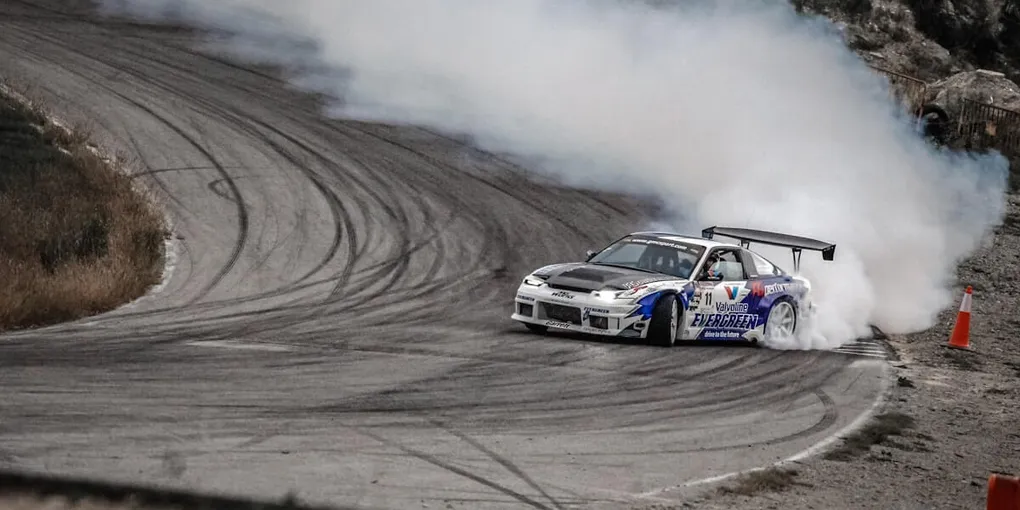

Formula Drift is the most misunderstood motorsport in the world. To the uninitiated, it looks like showboating — cars going sideways through clouds of tire smoke while a crowd cheers. But ask anyone who’s tried it: drifting at a competitive level demands throttle control, car setup knowledge, and spatial awareness that would humble most circuit racers.
The cars are 1,000+ horsepower monsters that cost six figures to build. The drivers are athletes who train for G-force tolerance and reaction time. And the judging — the part most critics dismiss as “subjective” — is structured, transparent, and brutally unforgiving.
How Judging Works
Unlike most motorsport, Formula Drift isn’t about lap times. Three judges score each run on four criteria:
- Line (30%) — Did the driver hit the clipping points? These are marked zones on the track (inner clips, outer zones) that the car must touch or cross. Missing a clip is an automatic deduction. The line is defined before the event and is the same for every driver.
- Angle (30%) — How much angle is the car carrying through each section? More angle = more points, but only if the car is still fast and controlled. A shallow drift with big smoke looks dramatic but scores poorly.
- Style (30%) — The subjective part. How aggressive was the initiation? Was the transition smooth? Did the driver maintain proximity to the lead car? Was there smoke, commitment, and showmanship? The judges sit together and calibrate their scores between runs to maintain consistency.
- Fluidity (10%) — A catch-all for how the run felt as a whole. Did the car flow smoothly between transitions? Was there hesitation or correction? A run with perfect angle and line but jerky transitions will lose points here.
The scoring system was designed to reward the qualities that made touge drifting exciting in the first place: commitment, precision, and the visual drama of a car pushed to the absolute limit of control.
Tandem Battles
Qualifying is solo runs. But the main event is tandem battles: two cars, lead and chase. The lead driver’s job is to run a perfect lap at maximum commitment. The chase driver’s job is to mirror the lead — matching angle, staying as close as possible (sometimes within inches), and applying pressure. If the chase driver runs a better line than the lead, they win. If the lead driver makes a mistake and the chase driver capitalizes, they win. If both run perfect laps, the chase driver wins — the tie goes to the pursuer, which incentivizes aggression.
The bracket is single-elimination. One bad run and you’re out. Championships come down to consistency across an entire season, but individual events are decided by who handles pressure better in the moment. A driver who qualified first can lose in the Top 32 to someone who squeaked in last, because tandem drifting is a fundamentally different skill from solo qualifying.
The Cars
Formula Drift cars are purpose-built competition machines hiding under production bodywork. Toyota Supras, Nissan Zs, Ford Mustangs, BMW M3s, and Chevy Corvettes dominate the grid. Underneath the familiar silhouettes are tube-frame chassis, sequential gearboxes, massive angle kits providing 60-70 degrees of steering lock, and engines producing 1,000-1,200 horsepower from heavily modified production blocks. A Formula Drift car costs between $200,000 and $500,000 to build and runs through a set of rear tires every two to three runs. Teams bring 30-40 tires to a single event.
The engineering is specialized in ways unique to drifting. Radiators are mounted in the rear to survive impacts — a front-mounted radiator in a drift car would be destroyed within the first lap of tandem, because the cars routinely make contact and the lead car’s rear bumper is exactly where the chase car’s nose ends up. Oil systems are designed with trap doors and extra capacity to maintain pressure at sustained extreme angles where a stock oil pan would starve the pickup within seconds. Steering racks are custom-built to handle the loads of opposite lock at speed — the forces involved in catching a slide at 100 km/h are orders of magnitude beyond what any production steering system was designed to endure. These are not street cars with mods — they are race cars built for a discipline that did not exist when most of their engines were designed.
Getting Into It
Formula Drift streams live on their website and YouTube. Start with a season opener from Long Beach or the finale at Irwindale — the “House of Drift.” The commentary does an excellent job explaining the judging criteria as the event unfolds, and the production team overlays graphics showing the clipping points and judging zones so you can follow along even if you don’t know the track.
Related: Curious about the physics that make drifting possible? Read how drifting works for the engineering behind going sideways. For the practical side of building a drift machine, see building a competitive drift car. And for grip-based cornering, trail braking is the polar opposite of drifting — but just as technical.