
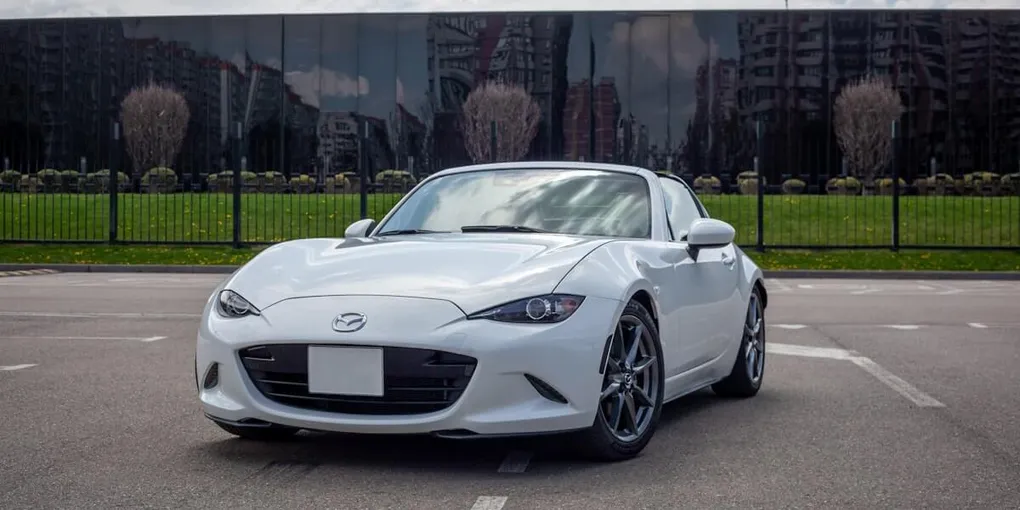

Over 1.2 million sold. Four generations spanning 35+ years.
The most-raced production car on the planet — and not by a small margin. On any given weekend, more Miatas are competing in amateur motorsport events worldwide than any other single model. Spec Miata racing alone runs on nearly every continent, and the cars are so evenly matched that races are routinely decided by inches after thirty minutes of wheel-to-wheel combat. The Miata’s racing success is not an accident. It is a direct result of the engineering philosophy that prioritized balance, reliability, and accessibility over peak numbers. A car that is easy to drive at the limit is a car that invites its owner to find that limit, and a car that is cheap to maintain at the limit is a car that keeps coming back for more. And yet, every time someone drives a Miata for the first time, they say the same thing: I get it now.
The Mazda MX-5 isn’t the fastest car. It isn’t the most powerful. It doesn’t have the best Nürburgring time. But none of that matters, because the Miata cracked a code that other manufacturers are still struggling to solve: how to make a car that’s pure joy.
British Roadsters, Japanese Reliability
The Miata’s origin story reads like a car enthusiast’s fever dream. In the early 1980s, American journalist Bob Hall told Mazda executives they should build a lightweight, affordable, rear-wheel-drive roadster inspired by the Lotus Elan and MGB. Remarkably, they listened.
The first NA Miata debuted in 1989 at the Chicago Auto Show. It weighed just 2,100 lbs, made 116 horsepower from a 1.6L twin-cam four, and featured pop-up headlights — an instant icon. But the real genius wasn’t the spec sheet. It was the engineering philosophy that Mazda calls Jinba Ittai — “horse and rider as one.”
Every Miata, from the NA through the current ND, has been built around this idea. The shifter snicks into gear with rifle-bolt precision. The steering talks to your palms. The chassis rotates exactly as much as you ask it to, and not a degree more.
Slow Car Fast > Fast Car Slow
Here’s the thing about 700-horsepower supercars: you can’t use them. On public roads, you’re at triple-digit speeds in three seconds, and then you’re just… managing terror.
The Miata? You can wring its neck through three gears, hear the engine sing all the way to 7,500 RPM, and at the top of third you’re doing 70 mph. You’re fully engaged, fully entertained, and fully legal.
That’s the Miata’s superpower. It gives you 10/10ths driving at 5/10ths speeds. Every commute becomes a back-road blast. Every on-ramp is an event. Every downshift is a reward.
Four Generations of Excellence
- NA (1989–1997): The original. Pop-ups, 2,100 lbs, analog everything. The purest expression of the formula.
- NB (1998–2005): Refined NA. No pop-ups, slightly stiffer chassis, still under 2,500 lbs.
- NC (2006–2015): The “boat” — heavier and softer, but still a brilliant chassis underneath. The PRHT power hardtop was a clever addition.
- ND (2016–present): Back to basics. 2,300 lbs, gorgeous styling, and a sky-high-revving 2.0L. Arguably the best Miata yet.
The Answer Is Always Miata
What other car has spawned spec racing series on every continent? What other car is equally at home at a track day, a drift event, an autocross, and a Sunday morning coffee run? What other car makes experienced automotive journalists break into spontaneous laughter during a press drive?
The Miata is proof that the best things in life aren’t the most expensive, the most powerful, or the most extreme. Sometimes, the answer really is that simple.
The Blank Canvas
Part of the Miata’s genius is how modifiable it is. Every generation has an enormous aftermarket ecosystem: suspension, forced induction, chassis bracing, aero, engine swaps. An ND Miata with coilovers, 200TW tires, and a proper alignment can lap within striking distance of cars costing three times as much. An NA Miata with a turbo kit and a hardtop becomes a legitimate track weapon. And at the extreme end, Flyin’ Miata’s V8 swaps produce Miatas with over 500 horsepower that weigh under 2,600 pounds — power-to-weight ratios that embarrass supercars. The Miata is not just a great sports car out of the box. It is the greatest platform car ever made, capable of becoming whatever its owner wants it to be.
The Miata’s legacy is not its spec sheet. It is the fact that you can buy a thirty-year-old NA for five thousand dollars, take it to a track day, and have as much fun as someone in a six-figure Porsche. It is the fact that every generation of the car has been true to the same idea: light, simple, rear-wheel-drive, manual, and joyful. In an era when sports cars are getting heavier, more expensive, and more automated, the Miata is an act of resistance. It is proof that the best things do not need to be the most powerful or the most expensive. They just need to be right. And the Miata has been right for thirty-five years.
Related: The Miata’s success is built on lightweight engineering — the same philosophy behind Mazda’s rotary engine program. For another iconic sports car born from stubborn engineering, see the history of Ferrari.
Miata Is Always The Answer.
The Miata’s greatest achievement is not its sales numbers or its racing pedigree. It is that after 35 years, four generations, and over a million cars, it still has no direct competitor. No other manufacturer has built a lightweight, affordable, rear-wheel-drive roadster that matches the Miata’s combination of reliability, affordability, and purity of purpose. The Toyota MR2 is dead. The Honda S2000 is dead. The Fiat 124 Spider borrowed the Miata’s platform and still couldn’t match it. The Miata won not by being the fastest or the most powerful, but by being the only car in its class that refused to compromise on what made it great.