

Ferrari is the only car company where the road cars exist to fund the race cars. That’s not a marketing slogan — it was literally the business model. The story of Ferrari is the story of a man who wanted to win races, sell a few cars to pay for it, and ended up building one of the most recognizable brands in human history.
The Racing Roots (1929–1947)
Enzo Ferrari wasn’t a manufacturer at first — he was a team boss. In 1929, he founded Scuderia Ferrari in Modena as Alfa Romeo’s official racing division. The prancing horse logo? That came from Italian WWI fighter ace Francesco Baracca, whose family suggested Enzo adopt it for good luck.
Scuderia Ferrari dominated pre-war Grand Prix racing with drivers like Tazio Nuvolari. But in 1939, Enzo left Alfa Romeo — contractually prohibited from using the Ferrari name on a car for four years. He founded Auto Avio Costruzioni and built the AAC 815 in 1940, but WWII put everything on hold.
In 1947, the war over, Enzo finally put his name on a car. The Ferrari 125 S — a 1.5L V12 — rolled out of the Maranello factory and won its first race at the Rome Grand Prix. Ferrari was officially in the car business. But make no mistake: the cars were a means to an end. Racing came first.
The Golden Era (1950s–1960s)
The 1950s and 60s were Ferrari’s imperial phase. On the track, drivers like Alberto Ascari, Juan Manuel Fangio, Mike Hawthorn, and Phil Hill won championships. The Ferrari 250 series — especially the 250 GTO — became the template for what a GT car should be: gorgeous, ferocious, and exclusive.
Road cars during this era were built in tiny numbers for wealthy clients. The 250 GT California Spyder, the 275 GTB/4, the 365 GTB/4 Daytona — every one of these cars is now worth more than most people’s houses.
This was also the era of the Ferrari-America rivalry. When Henry Ford II tried to buy Ferrari in 1963, Enzo pulled out of the deal at the last minute — allegedly over control of the racing program. Ford, humiliated, poured resources into the GT40 program to beat Ferrari at Le Mans. The result? Ford’s 1-2-3 finish in 1966, and one of the greatest grudges in automotive history.
The Modern Transformation (1970s–present)
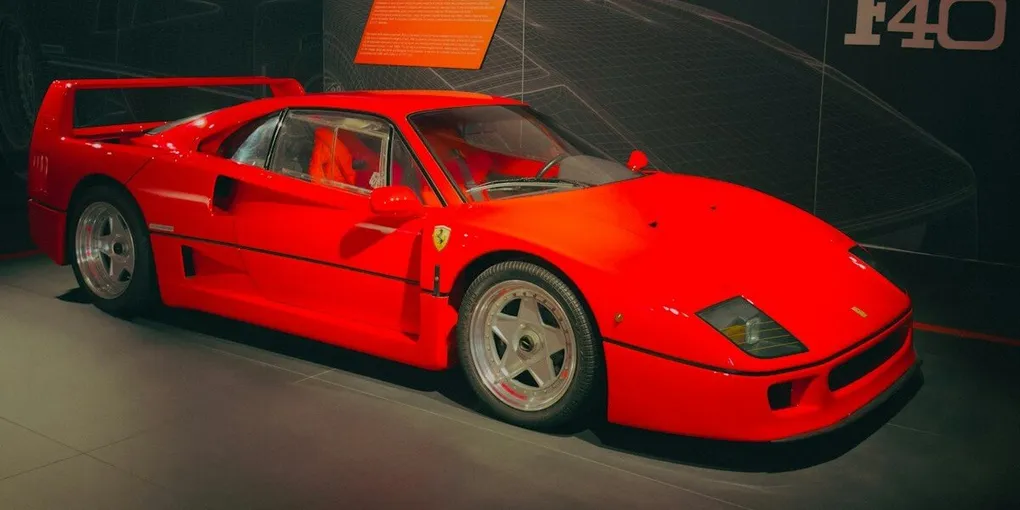
The 1970s brought the mid-engine revolution. The Berlinetta Boxer, then the Testarossa, then the 288 GTO and F40 — each one more extreme than the last. Ferrari wasn’t just a racing team that sold cars anymore. It was a supercar manufacturer that just happened to have a Formula 1 team. The F40 in particular, launched in 1987 to celebrate Ferrari’s 40th anniversary, was the last car personally approved by Enzo before his death. It had no carpet, no door handles, no radio — just a twin-turbo V8, a carbon-kevlar body, and a singular purpose. It set the template for every raw, uncompromising Ferrari that followed.
The F1 team’s dominance during the Michael Schumacher era (2000–2004, five straight championships) cemented Ferrari’s mythic status. The road cars kept getting faster: Enzo, LaFerrari, SF90 Stradale — hybrid hypercars pushing 1,000 horsepower.
The Ferrari Paradox
Here’s what makes Ferrari unique: they could sell more cars. They choose not to. Scarcity is the strategy. Each year, Ferrari deliberately builds fewer cars than demand requires, maintaining exclusivity and values. It’s infuriating if you’re on the waiting list. It’s brilliant if you’re a shareholder.
In 2015, Ferrari went public on the NYSE under ticker RACE. The company is now valued at over $70 billion — more than Ford or GM. Not bad for a racing team from Modena.
Ferrari’s greatest achievement is not any individual car or championship. It is that the company has survived — thrived — through decades of change that killed nearly every other boutique manufacturer. Maserati faded. Alfa Romeo became a shadow. Lamborghini was sold and resold. Ferrari remained Ferrari. That resilience is not an accident. It is the legacy of a man who understood that racing is not a marketing exercise. It is the product. Everything else — the road cars, the merchandise, the theme park — exists to fund the next race. And racing, for Ferrari, never stops.
Related: For another engineering-driven icon, see why the Porsche 911 stubbornly kept its engine in the wrong place — and made it work. And for a very different legend, here’s the Mazda Miata story.
The Legacy
Enzo Ferrari died in 1988 at age 90. He never saw Schumacher’s dominance, the LaFerrari, or the billion-dollar IPO. But the philosophy he embedded in the company — one that can be traced through every major milestone — is still there:
- 1947: First road car built purely to fund the racing team. The 125 S was not a product; it was a means to an end.
- 1969: Fiat buys 50% of Ferrari. Enzo retains full control of racing. The road car business scales, but the Scuderia remains untouchable.
- 1987: The F40 — the last car Enzo personally approved. Twin-turbo V8, carbon-kevlar body, no carpet, no door handles, no radio. The template for every raw Ferrari since.
- 2015: Ferrari IPO on the NYSE. The prancing horse becomes a $20 billion company. Passion and profitability, finally coexisting.
In every V12 that screams to 9,000 RPM and every F1 car that carries the prancing horse onto the grid, the message is the same: “We are not a car manufacturer that races. We are a racing team that builds cars.”
Enzo was not an engineer and not a driver — he was something rarer. He was a motivator. He pitted his drivers against each other deliberately, believing competition within the team sharpened both. When his star driver Niki Lauda was in the hospital with burns covering his face after the 1976 Nurburgring crash, Enzo had already started negotiating with other drivers to replace him. Lauda came back six weeks later and nearly won the championship. Enzo respected that more than any trophy.
Ferrari is proof that passion, stubbornness, and an almost irrational commitment to motorsport can build something immortal. The company has made mistakes — the Mondial, the 348’s handling, the California’s identity crisis — and survived all of them because the brand means something deeper than any individual car. It means racing. It means red over Maranello. It means a man who started as a team manager and ended as a myth. Every Ferrari that rolls out of the factory carries that weight. Some carry it better than others. But they all carry it. And that is why, seventy-five years later, we still care.