
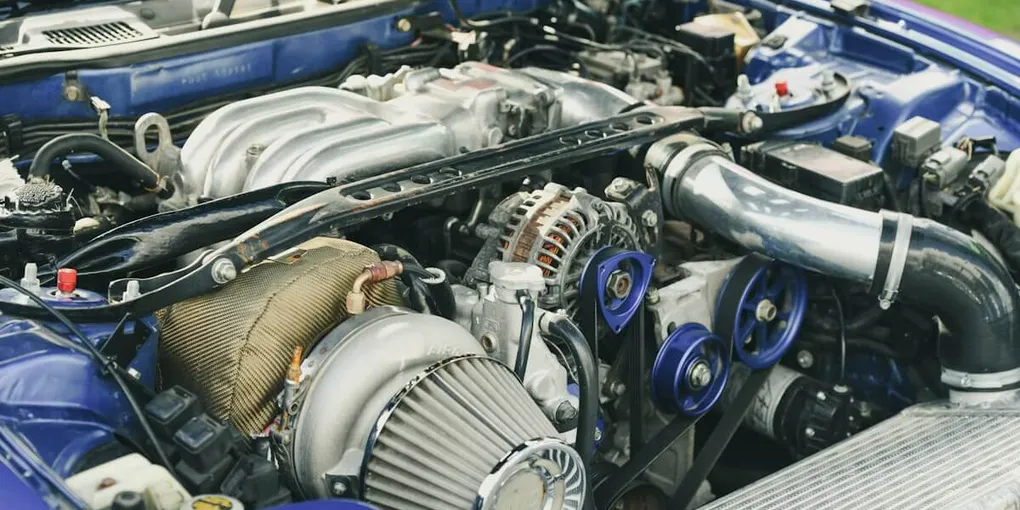

Most engines go up and down. The rotary goes round and round. And it nearly killed Mazda — twice — before becoming their identity.
How it works
Instead of pistons moving in cylinders, a triangular rotor spins inside an oval-shaped housing. As it rotates, it creates three chambers that handle intake, compression, combustion, and exhaust — all at once, in different parts of the housing.
The rotor is shaped like a Reuleaux triangle — a shape of constant width that can rotate inside an epitrochoid housing. Each face of the rotor has a pocket machined into it that determines the compression ratio. The rotor turns on an eccentric shaft (the rotary equivalent of a crankshaft), and for every one rotation of the rotor, the eccentric shaft spins three times. This is why a 1.3-liter rotary makes power like a 2.6-liter piston engine — it fires three times per eccentric shaft revolution versus a piston engine’s once per two revolutions.
The apex seals are the defining engineering challenge. They sit at each tip of the rotor, sealing the combustion chamber against the housing wall. They are small, spring-loaded metal strips that slide at enormous speed against the housing surface, enduring combustion temperatures and pressures while maintaining a gas-tight seal. They need constant lubrication — hence the rotary’s deliberate oil consumption — and they are the primary wear item. When apex seals fail, compression drops and the engine loses power. When they fail catastrophically, the rotor contacts the housing and the engine destroys itself.
- No valves — ports in the housing open and close as the rotor passes
- No reciprocating mass — nothing stops and reverses direction
- Power stroke every revolution vs every other revolution in a piston engine
The good
| Advantage | Why it matters |
|---|---|
| Power density | A 1.3L rotary makes power like a 2.6L piston engine |
| Smoothness | Zero vibration — no reciprocating parts |
| Compact | Tiny and light, ideal for mid-engine placement |
| High RPM | Loves to rev; 9,000+ rpm is normal |
| Sound | That distinct rotary brap is unmistakable |
The compactness is a genuine engineering advantage. A 13B rotary engine weighs about 250 pounds fully dressed. Compare that to a cast-iron LS V8 at 450+ pounds. In an RX-7, the rotary sits so far back and so low in the chassis that the weight distribution approaches 50/50 with the engine entirely behind the front axle — a mid-front layout that a piston engine of equivalent power simply cannot achieve without pushing the driver into the back seat.
The bad
| Issue | Reality |
|---|---|
| Fuel consumption | Awful. Like, really awful |
| Oil consumption | By design — oil is injected to lubricate apex seals |
| Apex seals | The Achilles’ heel; they wear and can fail catastrophically |
| Low torque | Makes power up high, nothing down low |
| Emissions | Hard to meet modern standards |
The cars
- Mazda Cosmo Sport (1967) — the first rotary production car. A futuristic grand tourer that announced Mazda’s ambitions to the world.
- RX-2, RX-3, RX-4 — 70s rotary sedans and coupes that brought the rotary to the masses
- RX-7 (1978-2002) — three generations of icon. The FB was the lightweight original. The FC brought turbocharging and independent rear suspension. The FD — twin-turbo, 276 hp (officially), timeless design — is the car people mean when they say “RX-7.”
- 787B (1991) — only rotary (and only Japanese car) to win Le Mans overall. Its four-rotor R26B engine produced 700 hp and sounded like nothing else on Earth.
- RX-8 (2003-2012) — four-door sports car, last production rotary. The Renesis engine addressed emissions but sacrificed the turbocharging that made the FD fast. It was brilliant to drive and frustrating to own, which is as rotary as it gets.
The rotary engine should not exist. It violates every conventional rule of internal combustion design. It burns too much fuel, uses too much oil, wears out too quickly, and fails emissions tests that piston engines pass without breaking a sweat. And yet — it won Le Mans outright, powered three generations of one of the greatest sports cars ever built, and inspired a loyalty among its owners that borders on religious devotion. The rotary is not the best engine ever made. It might not even be a good one by any objective measure. But it is the most interesting one, and in a world of increasingly homogenized automotive engineering, interesting counts for more than good.
Related: Mazda’s other obsession — the MX-5 Miata — proves they know how to build driver’s cars regardless of what’s under the hood. For another deep dive on forced induction, see turbochargers vs superchargers.
Is it coming back?
Mazda announced a rotary range-extender for the MX-30 PHEV. It doesn’t drive the wheels — just charges the battery. Purists groaned. But the spinning triangle lives on.
The rotary was always a solution looking for a problem that did not exist — an engine that was lighter, smoother, and more powerful per liter than its piston competitors, held back by fuel consumption, emissions, and a fundamental wear item that nobody ever fully solved. It should have died in the 1970s. Instead, it won Le Mans, powered three generations of one of the greatest sports cars ever built, and embedded itself so deeply in Mazda’s identity that the company is still tinkering with it fifty years later. The rotary is not coming back as a mainstream engine — the physics of combustion efficiency make that nearly impossible. But as a range extender, as a passion project, as a symbol of what happens when engineers are allowed to pursue a beautiful idea past the point where conventional wisdom says they should stop — the spinning triangle will outlive us all.