
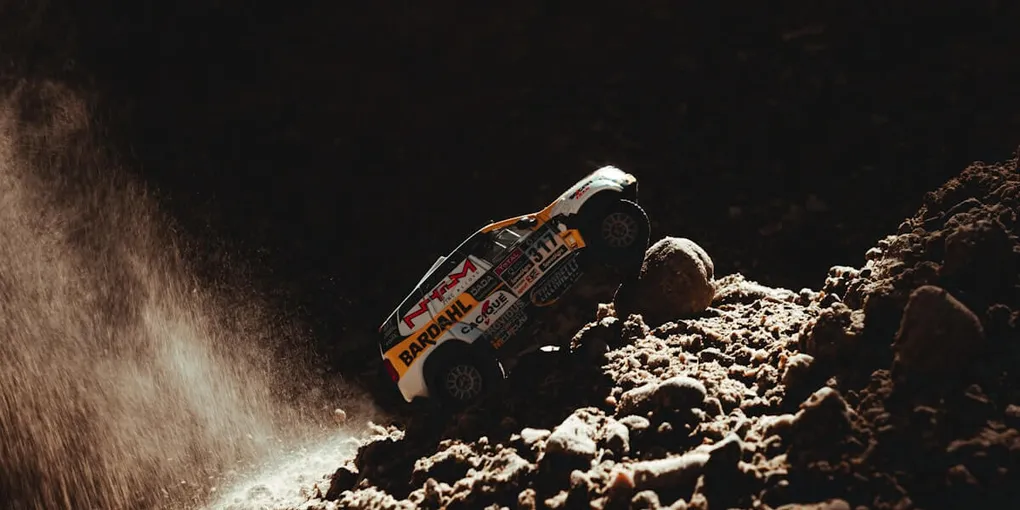

The Dakar Rally makes every other race look like a Sunday drive. Two weeks. Five thousand-plus kilometers. Temperatures that crack 50°C (122°F). Navigation so challenging that getting lost isn’t just likely — it’s expected. And every year, roughly half the field doesn’t finish.
From Paris to… Saudi Arabia
The rally started in 1978 as Paris-Dakar, running from France through North Africa to Senegal’s capital. The route crossed the Sahara Desert in stages up to 900 km long, through countries that had never seen organized motorsport. Navigation was done with paper maps and a compass. Breakdowns in the middle of nowhere were routine. Competitors slept in the desert. Some never came back.
After security concerns — including terrorist threats in Mauritania that forced cancellation in 2008 — the event moved to South America (2009-2019), running through Argentina, Chile, Peru, and Bolivia. The terrain changed from sand dunes to high-altitude deserts and Andes mountain passes, but the brutality didn’t. In 2020, the rally relocated again to Saudi Arabia, where it now runs a loop course through the Arabian Desert’s Empty Quarter — some of the most unforgiving sand on Earth.
The name “Dakar” stuck through all of it, even though the rally hasn’t visited Senegal in over 15 years. That’s how iconic the brand became.
The Classes
Dakar isn’t one race — it’s five running simultaneously:
- Cars (T1) — The premier class. Toyota Hilux, Mini JCW Buggy, Prodrive Hunter, and Audi’s revolutionary RS Q e-tron (electric drivetrain with a range-extender engine). The Audi was the first electrified car to win in 2024, driven by Carlos Sainz Sr.
- Bikes (Moto) — The most dangerous class. Riders navigate alone, with no co-driver, at speeds exceeding 170 km/h across dunes. They carry their own tools, fix their own bikes, and race for up to 10 hours a day. Since the rally’s founding, over 30 competitors have died.
- Trucks — 10-ton monsters from Kamaz, Iveco, and Tatra. Watching a Dakar truck catch air over a dune crest is genuinely terrifying. They race the same stages as the cars and bikes but carry three crew members.
- Quads — Four-wheelers, the smallest class. The riders endure the same physical punishment as the Moto class on a less capable platform.
- Classic — A regularity rally for vintage Dakar vehicles. Cars and trucks from the 1980s and 1990s run a parallel course with an emphasis on precise navigation rather than outright speed. It’s less competition, more pilgrimage.
The Navigation
This is what makes Dakar unique. Competitors receive a roadbook each morning — a scroll of tulip diagrams and distances. No GPS routing, no pre-running. They must navigate 400-500 km of open desert using only these instructions, a compass, and their wits.
The roadbook uses a standardized system of symbols: CAP headings, distance markers, hazard warnings. Misread one symbol and you can drive 50 km in the wrong direction before realizing it. Every year, top contenders lose hours — sometimes entire rallies — to navigation errors. In 2023, Sebastien Loeb, a nine-time WRC champion and arguably one of the greatest drivers alive, lost the Dakar because he got lost in the dunes.
Dunes shift. Tracks disappear. Waypoints are hidden in valleys. Finding them is as important as being fast. Many Dakars have been won and lost at 40 km/h in the dust, not 180 km/h on the flats.
The Attrition
Finishing Dakar is an achievement. Winning it is something else entirely. The attrition rate hovers around 50% most years — half the field will not see the finish podium. Mechanical failures are the most common culprit, but exhaustion, dehydration, crashes, and navigation errors all take their toll. The medical team treats hundreds of competitors during the event for everything from broken bones to severe heatstroke.
The bikes are the worst. Riders lose up to 5 kg of body weight over the two weeks. Some report hallucinations from fatigue. The combination of physical exhaustion and the mental load of high-speed navigation through featureless terrain is unique in sport — there is no other event where athletic endurance and cognitive performance are so tightly coupled, and where a single navigation error can cost you hours or end your rally entirely. The riders in the Moto class are also the only competitors who are completely alone — no co-driver, no support vehicle within radio range, no one to help if they crash. If a bike goes down in the dunes, the rider has to pick it up themselves, assess the damage, and decide whether to continue or activate the emergency beacon and wait, potentially for hours, for a medical helicopter that may not be able to land in the terrain they are in.
Related: For rally racing on paved and gravel roads (vs. open desert), see WRC vs Rallycross. And for the cars that made rally legendary, here are the greatest rally cars of all time.
Dakar is not the fastest motorsport. It is not the most technically complex. But it is, without question, the hardest. No other race asks competitors to navigate, survive, and compete simultaneously for two weeks through terrain designed by geology to destroy machinery. The trophy is not a prize. The trophy is proof you made it back.