
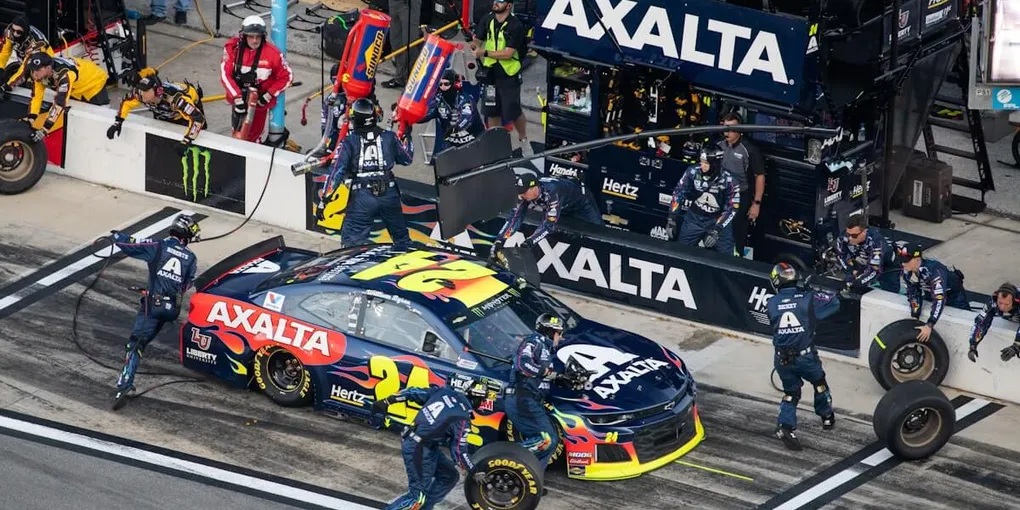

NASCAR gets a bad rap. “It’s just turning left,” they say. “It’s boring.” But the math tells a different story: 40 cars, 3,400-pound machines, 200 mph, inches apart, for 500 miles, with no driver aids, no ABS, no traction control. If it were easy, everyone would do it.
The Engineering
A Cup Series car is a marvel of controlled chaos. The Gen 7 car (Next Gen), introduced in 2022, is the most advanced NASCAR ever:
- Independent rear suspension — for the first time in Cup history, replacing the solid rear axle that dated back to the 1940s. This single change transformed the car’s behavior on road courses and brought NASCAR’s suspension technology into the 21st century.
- Sequential 5-speed gearbox — no more H-pattern, but still no paddle shifters. Drivers shift with a sequential lever, pulling back to upshift, pushing forward to downshift. It requires heel-toe rev matching on downshifts and punishes sloppy technique.
- Symmetrical body — the car is built to turn left and right, even if the schedule still leans heavily oval. The old cars had asymmetrical bodies warped to gain side force on ovals. The Next Gen is the first NASCAR with a body designed first for road racing aero.
- Underbody aero — a flat floor and rear diffuser generate downforce cleanly, reducing the turbulent air that made passing difficult. This is technology lifted directly from prototype and GT racing, and it is the single biggest reason the road course racing has improved so dramatically since 2022.
- Single lug nut wheels — a small change that seems trivial, but it transformed pit stops from 5-lug impacts into a single center-lock operation, cutting stop times and reducing the impact of pit crew errors on race outcomes.
The Skill
Oval racing looks simple from the outside. It’s not. Consider:
- Tire management: 500 miles on one set of tires means drivers spend more time managing degradation than pushing. The fastest car on lap 1 is rarely the fastest car on lap 400. A driver who overworks their tires early — sliding the car, overheating the tread — pays for it with terminal understeer as the run progresses. The great oval drivers are the ones who can feel tire wear in real time and adjust their driving to compensate.
- Drafting: At superspeedways (Daytona, Talladega), cars run in packs inches apart. One wrong move collects 20 cars. The precision required at 190 mph is staggering. The aerodynamic forces involved are enormous — a car running in the draft uses up to 30% less fuel and can maintain a higher top speed than a car running alone. The strategic layer is choosing when to push, when to lift, and which lane to commit to, all at closing speeds that give you less than a second to decide.
- Track evolution: An oval changes dramatically over a race. The groove moves, marbles build up, and the fast line from qualifying may not be the fast line on lap 300. The outside lane that was undrivable on lap 50 might be the only place with grip by lap 400. Drivers constantly adapt, feeling the grip change corner by corner.
Beyond Ovals
NASCAR runs road courses too: Watkins Glen, Sonoma, COTA, and the Charlotte Roval. These weekends showcase a completely different skillset — trail braking, downshifting, and apex hunting — and they’ve produced some of the best racing in the series’ history. The Chicago street course, added in 2023, brought NASCAR to a downtown circuit for the first time in its modern era. Watching a Cup car thread through 90-degree city corners between concrete walls is a fundamentally different experience from watching it draft at Daytona — and it proves that these cars are versatile in ways their critics refuse to acknowledge.
NASCAR is not F1, and that is the point. It is a different engineering challenge, a different driving challenge, and a different philosophy of what racing should be. The drivers who excel on ovals — the ones who can feel tire wear through the steering wheel at 190 mph, who can read the air and know when to make the move, who can manage 500 miles of mental focus without a single lapse — are operating at a level that any racing driver in any discipline would respect. The cars are different. The tracks are different. The skills are different. But the fundamental thing — a human being pushing a machine to its absolute limit — is exactly the same.
NASCAR is the most watched form of motorsport in America for a reason, and it is not just tradition. The racing is close, the stakes are high, and the access drivers give to fans is unmatched in professional sport. Walk through the garage area at a Cup race and you will see drivers signing autographs an hour before they climb into the car. Try that at an F1 paddock. The culture is different. That does not make it worse. For a lot of people, it makes it better.
Related: For the deep engineering behind the setup — asymmetric suspension, flat-floor aero, and how teams find speed in a spec chassis — read inside a NASCAR Cup car. For open-wheel comparison, see F1 vs WEC vs WRC. For the cornering technique NASCAR drivers lean on at road courses, check out trail braking explained.