
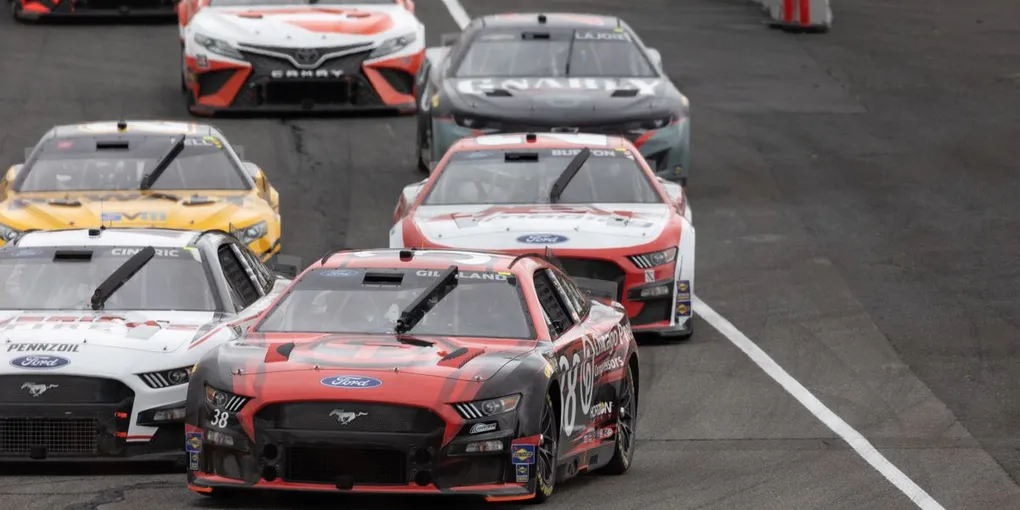

A NASCAR Cup car is the strangest race car in professional motorsport. It is built lopsided on purpose. Its suspension is tuned differently left to right. Its body is symmetrical but its aero balance is anything but. And the entire engineering philosophy — from shock packages to rear differential settings — is optimized for one thing: turning left at 200 mph for 500 miles.
The basics of what a Cup car is — the Next Gen chassis, the independent rear suspension, the sequential gearbox — are well covered elsewhere. This is about what happens under the skin. The setup secrets. The physics. The engineering that makes a car that should understeer into the wall instead carve perfect arcs at triple-digit speeds.
Why the Car Is Crooked
This is the first thing every road-racing engineer notices when they see a Cup car sitting still: it does not sit level. The right side is lower than the left. The tires are not cambered equally. The springs are not the same rate. This is not a flaw. It is the entire point.
An oval corner is one long, sustained turn. At a track like Homestead with 18-20 degrees of banking, the car spends roughly 70% of the lap in a corner. The forces on the chassis — lateral load, vertical compression, aerodynamic push — are biased heavily to the right side. If the car were set up symmetrically, the right-front tire would collapse under the load while the left-front did nothing. The right side would bottom out. The car would push up the track like a shopping cart with a bad wheel.
So the car is built crooked to match the corner. The right-front spring is stiffer — sometimes by over 100 lb/in — to resist compression under load. The right-front runs significantly more negative camber, often exceeding negative four degrees, to keep the contact patch flat when the tire is loaded hardest mid-corner. The left-front sits closer to zero camber since it sees far less load.
Right-rear toe is biased to help rotation. On corner entry, the right-rear points slightly outboard, creating a rear-steer effect that helps the car rotate without the driver having to throw the wheel. It is a passive four-wheel-steer system achieved entirely through static alignment.
Ride height split can exceed half an inch from left to right. The right frame rail runs lower to manage the compression stroke through the banking. The left side sits higher to avoid bottoming out on bumps that the right side soaked up two seconds ago. Truck arms and track bar settings — old-school hardware that still exists under the Next Gen body — let teams tune rear roll center independently of everything else.
Flat Floor, No Excuses
The Next Gen car introduced a flat floor and rear diffuser — concepts lifted from prototype and GT racing. This was the single biggest philosophical shift in NASCAR’s history. For decades, stock cars had open underbodies with components hanging into the airstream, creating enormous drag and unpredictable aero behavior. The flat floor changed everything.
Here is why it matters. A flat floor accelerates airflow under the car, creating a low-pressure zone between the chassis and the track surface. The lower the pressure, the harder the car is sucked down. This is ground effect — the same principle that made 1970s F1 cars corner at impossible speeds and that modern F1 returned to in 2022.
On a NASCAR oval, ground effect does something specific: it works at very low ride heights but loses effectiveness as ride height increases. When a car enters the corner and the right side compresses under load, the floor gets closer to the track on that side, increasing downforce right where it is needed most. On corner exit, as the car unloads and ride height rises, the downforce bleeds off — reducing drag on the straights. It is a self-regulating system tuned entirely through static ride height and spring rate selection.
The diffuser at the rear accelerates the airflow exiting from under the car, further dropping pressure and increasing downforce. Teams tune diffuser effectiveness through rear ride height and the angle of the diffuser strakes. A half-degree change can shift aero balance by several percentage points — the difference between a car that pushes on entry and one that rotates freely.
The Tapered Spacer and the Art of Being Slow to Go Fast
Superspeedways — Daytona and Talladega — have their own physics. Since 2022, engine output is capped by a tapered spacer (the modern successor to the restrictor plate) that limits airflow into the engine. The result: roughly 510 horsepower versus 670 hp everywhere else.
With power capped, the only performance variable is drag. A car running alone punches a hole in the air. The car behind slips through that hole, using up to 30% less energy to maintain the same speed. Two cars working together are faster than one car alone. A pack of 20 cars is faster still.
The physics of the draft are brutal in their simplicity. The leading car is disadvantaged — it does the aerodynamic work while everyone behind benefits. But the leader controls the lane. A driver who pulls out of line too early gets swallowed by the pack. A driver who waits too long never gets the run. Timing the move — picking the moment when the car behind has built enough momentum, the lane ahead is clear, and the run will stick — is less engineering than art, but the underlying physics are deterministic. It is a multiplayer optimization problem played at 190 mph with 40 participants and no margin for error.
Teams influence drafting performance through cooling drag. Opening the grille and brake ducts cools the engine and brakes but increases drag. Closing them reduces drag but risks overheating. On a superspeedway, where the car spends most of its time in a pack with reduced airflow, cooling is already compromised. The setup is a tightrope: too much cooling and the car is slow in clean air. Too little and the engine cooks after 20 laps in the draft.
Finding the Edge in a Spec World
The Next Gen car is a spec chassis with spec bodywork. Every team gets the same tub from Technique Chassis. The same Xtrac transaxle. The same body panels from the OEM (Ford, Chevy, Toyota). Within these constraints, where does performance come from?
Shock packages. This is the biggest differentiator. Teams run custom-valved shocks with extremely specific digressive curves — stiff at low shaft speeds for platform control during cornering, softer at high speeds to absorb bumps and curbs. The valving is proprietary, developed over thousands of hours of seven-post rig testing, and closely guarded. A good shock package can buy two-tenths per lap on a car with identical springs and bars.
Body placement. Though the body panels are spec, their exact positioning on the chassis is not. Teams shift panels within the allowed tolerance envelope — fractions of an inch forward or back, up or down — to tune the relationship between the front splitter and the track surface, the rear wing angle of attack, and the side force generated by the body sides. These are tiny adjustments with outsized effects at 200 mph.
Pit crew execution. Not engineering in the traditional sense, but race outcomes are increasingly decided by pit stop performance. Here is how the top teams separate themselves:
- Athletic training: Pit crews train like professional athletes — weightlifting, agility drills, nutrition plans. A tire carrier who is half a second slower over 40 feet costs the team positions every single stop.
- Video analysis: Every stop is filmed from multiple angles and reviewed frame by frame. Teams measure the time from when the car hits the pit box to when each tire comes off, goes on, and the jack drops.
- Equipment optimization: NASCAR regulates the number of lug nuts (five per wheel) and the tools used, but teams still find margins — custom gun speeds, optimized air pressure, lube on the studs before the race.
A four-tire stop in 10 seconds versus 11 seconds can gain or lose five positions on pit road.
The NASCAR Cup car is a paradox. It is a spec car that teams spend millions differentiating. It is an oval car that uses road-racing aero. It is lopsided in the garage and balanced at 200 mph. None of this is an accident. It is the result of decades of engineering evolution within a rulebook that rewards creativity in the margins. NASCAR is not simple. It is simply subtle.
Related: For the broader picture — the Next Gen car, the driving skills, and why NASCAR deserves a second look — read NASCAR: it’s not just left turns. For how NASCAR compares to other top-tier racing, see F1 vs WEC vs WRC.