

Walk through a GT3 paddock and the first thing you notice is how normal the cars look. A Porsche 911 GT3 R looks like a Porsche 911. A Ferrari 296 GT3 looks like a Ferrari 296 GTB. The silhouette, the headlights, the engine block — they all trace back to a car you could buy from a showroom.
But that familiarity is the only thing normal about them. Everything else — suspension geometry, aero package, weight distribution, electronics — is pure racing engineering. The result is a car that laps circuits only a few seconds slower than a prototype, costs about half a million dollars, and lets a gentleman driver and a factory pro race on the same grid.
The Chassis
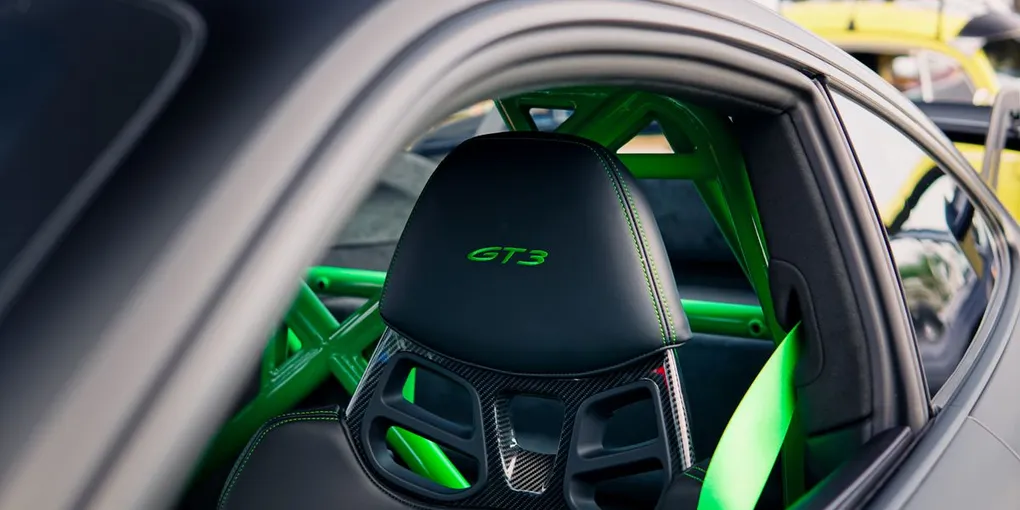
GT3 cars start with a production monocoque. The roll cage — mandatory in all FIA-sanctioned racing — is welded directly to the chassis, structurally reinforcing the entire car. The cage alone transforms the torsional rigidity of a road car shell into something race-worthy.
Suspension is a complete departure from the road car. Double wishbones replace MacPherson struts where packaging allows. Multi-link rear setups get racing-specific geometry — adjustable camber, caster, toe, and bump steer. Ride height drops significantly from road spec, often running 50-70 mm of ground clearance depending on the track. Spring rates are astronomical compared to road cars — GT3 cars run springs in the range of 200-300 N/mm at the front, versus 30-50 N/mm for a road-going 911.
Dampers are four-way adjustable Öhlins, KW, or Sachs units — separate adjustments for low-speed compression, high-speed compression, low-speed rebound, and high-speed rebound. A single click can change the car’s behavior through a specific corner. Setup sheets for a Spa 24 Hours weekend run to dozens of pages.
Aero
GT3 aero is deceptively simple. The rulebook caps the dimensions of the rear wing and front splitter, and teams cannot run active aero or DRS. Within those constraints, development focuses on efficiency — generating downforce with minimal drag.
A typical GT3 car produces roughly 600-800 kg of downforce at 250 km/h, depending on the specific model and circuit setup. That is less than half what an LMP2 prototype generates, but GT3 cars weigh 1,300-1,350 kg versus 950 kg for an LMP2 — so they need proportionally less.
What matters more than peak downforce is balance. A GT3 car that understeers at 200 km/h is dangerous; one that oversteers unpredictably is worse. Teams spend hours in wind tunnels and CFD simulations chasing aero balance — ensuring the front splitter and rear wing work together across the full range of ride heights and yaw angles the car sees on track.
The floor and diffuser do significant work too. Unlike road cars with flat undertrays, GT3 cars run sculpted floors that accelerate airflow under the car, creating a low-pressure zone that sucks the car down. This is ground effect — the same principle that dominated F1 in the late 1970s and returned in 2022.
Balance of Performance
No discussion of GT3 engineering is complete without BoP. The FIA’s Balance of Performance system adjusts each car’s weight, power, and ride height to equalize performance across the grid. A Bentley Continental GT3 weighs about 1,350 kg and runs with restricted boost. A Lamborghini Huracan GT3 weighs closer to 1,280 kg. The goal: all cars should be capable of identical lap times regardless of engine layout, weight, or aero philosophy.
Teams complain about BoP constantly. It is part of the sport. But without it, GT3 would not exist — manufacturers would not invest millions in a racing program if the car they built last year was uncompetitive before it turned a wheel. BoP makes the racing close, and close racing makes the class work.
Driving a GT3 Car
GT3 cars are not prototypes. They do not have the downforce of an LMP2 or the power of a DPi. You cannot throw them into a corner and rely on aero grip to catch you. They demand a smooth, precise driving style — trail braking deep into the apex, using the weight transfer to rotate the car, and getting on the throttle early to use the rear diffuser.
ABS and traction control are permitted, which separates GT3 from pure prototype and formula racing. But the systems are racing-spec, not road-car intrusive — they intervene at the limit, not before it. A driver who leans on them loses time because every intervention is a micro-correction that scrubs speed. A driver who works with them gains consistency by setting the traction control to the minimum setting that keeps the rear tires from lighting up on exit and adjusting the ABS threshold so it only engages under truly emergency-level brake pressure. The electronics are not a crutch — they are another setup variable, tuned corner by corner like damper settings or tire pressures. The best drivers find the line where the systems are present but not active, driving at the very edge of the electronic envelope without triggering it.
The best GT3 drivers — factory pros like Maro Engel, Raffaele Marciello, and Jules Gounon — have a distinctive style: extremely smooth hands, minimal steering corrections mid-corner, and a metronomic consistency that lets them run within two-tenths of their qualifying time for an entire stint.
What makes GT3 unique in the racing world can be summed up in three points:
- Production-based, not purpose-built. The chassis starts on an assembly line, not in a composites lab. The engine block is the same casting found in the road car. This keeps costs manageable and attracts manufacturers who want to showcase their showroom models.
- The most diverse grids in motorsport. Factory pros share the track with amateur drivers who funded their own seats. Six to ten manufacturers represented in every race. The cars look and sound different because they are different — a Ferrari 296 GT3 is not a rebodied Porsche 911 GT3 R.
- Aero that works with the tires, not instead of them. GT3 cars have significant downforce but nothing like an LMP2 or F1 car. The driver still has to manage weight transfer and mechanical grip. The car communicates through the steering wheel, not just through data logs.
Related: For endurance racing at its most extreme, read about Le Mans and the 24-hour format. For a comparison with open-wheel racing, see F1 vs WEC vs WRC.