
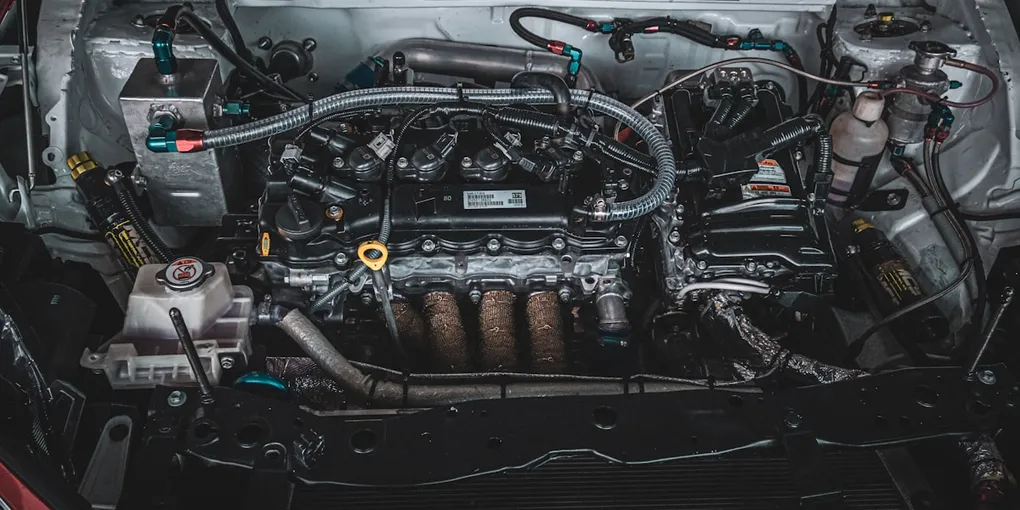

Where the engine sits isn’t a styling choice. It’s the single biggest decision that shapes how a car turns, stops, and puts power down.
Three layouts. Three completely different personalities.
The Physics: Polar Moment of Inertia
Think of a figure skater. Arms out = slow spin. Arms in = fast spin. Same mass, different behavior.
In a car, the heaviest thing is the engine. Where you put it determines the polar moment of inertia — how much the car resists rotating. Low polar moment (mass concentrated near the center) = eager to turn, quick to react. High polar moment (mass at the ends) = stable, resists rotation.
Simple test: pick up a dumbbell by the middle and twist it. Now grab it by one end and twist. That difference is what we’re talking about.
Front-Engine: The Everyman
Most cars. Engine up front, usually over or ahead of the front axle. 52-58% of weight on the front tires.
| Front-Engine | |
|---|---|
| Weight distribution | 52–58 / 48–42 |
| Turn-in feel | Needs patience, trail braking helps |
| Exit traction | Rear tires lightly loaded — early throttle means wheelspin or understeer |
| Limit behavior | Understeer first — safe, predictable |
| Best example | Mustang GT, GR Corolla (front-engine AWD) |
Some front-engine cars get closer to the ideal than others. Subaru’s boxer engine sits low and pushed back — a “front-mid” layout. The GT86 and BRZ achieve 53/47 weight distribution with it, which is within spitting distance of some mid-engine cars. The Miata’s engine is similarly tucked behind the front axle line. That’s why these cars rotate like something more expensive — the mass is closer to the center than a traditional front-engine layout like the Mustang, where the engine hangs over the front axle.
On the street, front-engine is king for daily use. Four seats, a trunk, predictable limits. On track, you fight understeer unless the car was designed from the start to rotate (GT86, Miata).
Mid-Engine: The Purist
Engine behind the driver, ahead of the rear axle. Cayman, 458, Huracán, Artura.
| Mid-Engine | |
|---|---|
| Weight distribution | 42–45 / 58–55 |
| Turn-in feel | Immediate. Telepathic. |
| Exit traction | Excellent — weight over the drive wheels |
| Limit behavior | Neutral… then snap oversteer |
| Best example | Porsche Cayman GT4 |
Low polar moment means the car rotates now. The mass is clustered around the driver’s hips — it feels like the car pivots around you. Turn-in happens the moment you think about it.
But that same quality bites at the limit. When a mid-engine car lets go, it lets go fast. There’s no lazy understeer warning you. One moment you’re carrying speed through a sweeper, the next you’re facing backwards. The Cayman GT4 is arguably the best-handling car under $150k because of this immediacy. It also spins faster than you can countersteer if you lift mid-corner on cold tires. That’s the trade. Telepathic response means unforgiving consequences.
On the street, you sacrifice everything for that feel. No back seats. Trunk fits a backpack. Engine access requires removing body panels.
Rear-Engine: The 911
Engine behind the rear axle. One company has made this work: Porsche.
| Rear-Engine | |
|---|---|
| Weight distribution | 38–40 / 62–60 |
| Turn-in feel | Light nose — needs trail braking to plant it |
| Exit traction | Unmatched. Weight over drive wheels = monster grip |
| Limit behavior | Oversteer — the pendulum |
| Best example | Porsche 911 (any generation) |
Physics says hanging roughly the weight of a grand piano behind the rear axle should be a disaster. Early 911s earned their reputation honestly — lift off mid-corner, weight transfers forward, the rear goes light, and the engine pendulum swings you around.
Porsche has spent 60 years fighting this with wider rear tires (305mm+), rear-axle steering, and electronics. But the 911 still demands a specific technique: early brake, trail deep into the corner to plant the nose, then use the rear grip to explode out. It’s a unique rhythm. Once you learn it, nothing exits corners like a 911.
So Which One?
They’re different tools for different jobs.
Want immediacy? Mid-engine. The Cayman feels alive in your hands. But it’ll punish mistakes harder than anything else on this list.
Want versatility? Front-engine. The GT86/Miata formula gives you 90% of the fun with actual livability.
Want something that demands you learn its language? Rear-engine. A 911 rewards skill more than any other layout. It’s not easier — it’s more interesting.
Related: Once you understand where the weight goes, see how AWD, RWD, and FWD change the equation. And for the suspension that keeps it all planted: springs, dampers, and anti-roll bars.