
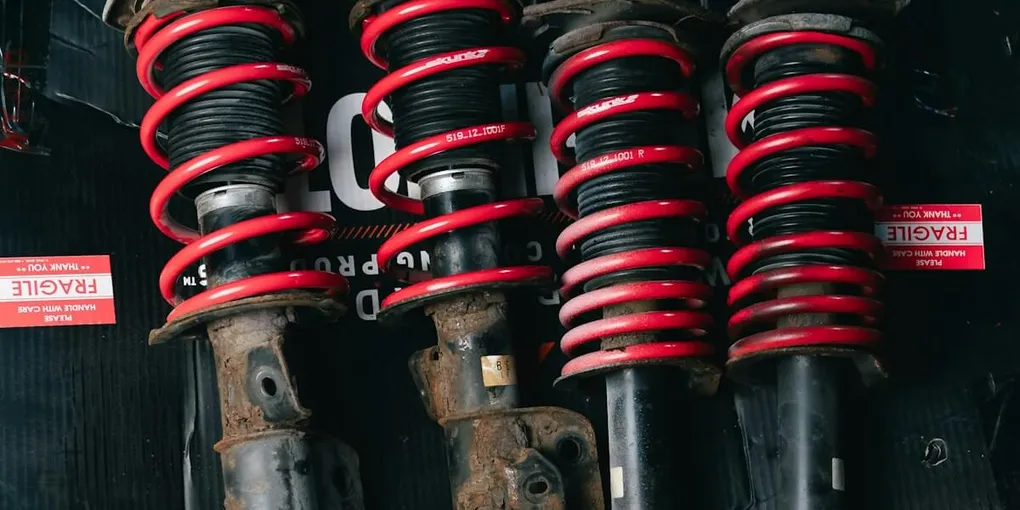

Suspension is one of those things most people don’t think about until it breaks — and then they think about it a lot, usually while bouncing down the highway like a pogo stick. But suspension isn’t just about comfort. It’s the system that keeps your tires in contact with the road, and understanding it will make you a better driver and a smarter modifier.
The Big Three
Every suspension system — from a base-model Corolla to a GT3 RS — boils down to three components working together.
Springs: The Energy Managers
Springs support the weight of the car and absorb bumps by compressing and releasing. They determine your ride height and, along with the dampers, set the baseline for how stiff or soft the car feels.
Common types:
- Coil springs: What you’ll find on most modern cars. Compact, reliable, and available in progressive rates (gets stiffer as it compresses) or linear rates (consistent stiffness throughout travel).
- Leaf springs: Old-school tech, still used on trucks and some rear suspensions. Simple, durable, and great at load-bearing — less great at sophisticated handling.
- Torsion bars: A metal bar that twists to absorb bumps. Used on some classic Porsches and older trucks. Compact packaging, but harder to tune.
What spring rate does: A higher spring rate (measured in lbs/in or kg/mm) means a stiffer spring. Stiffer springs reduce body roll and keep the car flatter in corners, but they also reduce mechanical grip on bumpy surfaces because the tire can’t follow the road as well. On a perfectly smooth track, stiff springs are faster. On a real road with camber changes and potholes, too much spring rate makes the car skip across imperfections rather than absorbing them, and the resulting loss of contact-patch consistency costs more time than the reduced body roll saves. It’s always a trade-off — one that OEM engineers spend thousands of hours optimizing for the specific roads their cars will actually be driven on, balancing the conflicting demands of ride comfort, handling precision, and cost.
Dampers (Shock Absorbers): The Motion Controllers
Here’s the thing most people get wrong: dampers don’t absorb bumps — springs do. Dampers control the speed at which springs compress and rebound. Without dampers, your car would bounce up and down like a slinky until the energy dissipated.
A damper works by forcing hydraulic fluid through small valves. The resistance creates damping force. More resistance = stiffer damping = less body movement but a harsher ride.
Key damping concepts:
- Compression (bump): Controls how fast the spring compresses when you hit a bump or the car leans in a corner.
- Rebound: Controls how fast the spring extends back. Too little rebound and the car feels floaty and unsettled. Too much and the suspension “packs down” over repeated bumps, losing travel.
- Adjustable dampers: High-end setups let you tune compression and rebound independently. This is the rabbit hole where track-day enthusiasts disappear for years.
Anti-Roll Bars (Sway Bars): The Balance Tuners
Anti-roll bars are torsion springs mounted across the car, connecting the left and right suspension. When the car leans in a corner, the bar twists and resists the motion, reducing body roll.
Why they matter: An anti-roll bar essentially adds spring rate only in corners. On a straight road, it does nothing — so you can have a compliant ride and reduced body roll.
Tuning with anti-roll bars:
- Stiffer front bar: Reduces front body roll, but shifts grip balance toward understeer (the front washes out first).
- Stiffer rear bar: Reduces rear body roll, shifts grip balance toward oversteer (the rear steps out).
- This is the cheapest handling mod you can make. A set of adjustable sway bars costs a few hundred bucks and can transform how your car rotates.
How It All Works Together
Imagine a car entering a corner:
- The driver turns the wheel. Weight transfers to the outside tires.
- Springs on the outside compress, springs on the inside extend. The body rolls.
- Dampers resist that roll, controlling the rate at which the car leans over.
- Anti-roll bars add resistance to the roll, keeping the car flatter and managing which axle takes more of the cornering load.
- Throughout all of this, the goal is constant: keep the tire contact patches as large and consistent as possible.
Related: Suspension keeps the tires planted — the differential decides which tire gets the power. Together they’re the two biggest factors in how your car handles a corner.
The Takeaway
Suspension tuning is about balance. Change one thing and you affect everything else. Stiffer isn’t always better — the fastest setup is the one that keeps the tires on the ground. And if you’re going to modify one thing? Start with good dampers. Spring rate sets the baseline, but damping determines how the car actually feels — and how much confidence you have when you lean on it.
Now go forth and stop calling them “shocks.” They’re dampers. The springs are what shock-absorb. And now you know why.