

Every car forum has this thread. Some guy with a tune-only Golf R insists AWD is the only answer. A Miata owner counters with “purity.” The FWD crowd posts Nürburgring times.
Here’s the thing: the correct answer depends entirely on what you’re doing with the car. Not what the spec sheet says. Not what your favorite YouTuber drives. Physics.
The Core Difference
Only one axle steers. But which axle drives — and how many — changes everything.
| FWD | RWD | AWD | |
|---|---|---|---|
| Driven wheels | Front | Rear | All four |
| Weight distribution | 60/40 front-heavy | 50–55/50–45 | 55–60/45–40 |
| Default limit behavior | Understeer | Oversteer | Neutral → understeer |
| Steering feel | Torque steer, numb | Clean, communicative | Heavy, sometimes vague |
| Wet/snow traction | Good | Requires skill | Excellent |
| Weight penalty | Lowest | Low | ~70–120 kg extra |
FWD: The One Everyone Loves to Hate
Front-wheel drive carries a stigma. “Wrong-wheel drive.” “Can’t put power down.” Let’s be honest about it.
FWD is efficient. The engine, transmission, and driven wheels are all in one package — no driveshaft running to the rear, no rear differential. It’s cheaper to build, lighter, and packaging is clean. That’s why almost every economy car uses it.
The problem is physics. Under acceleration, weight transfers backward — away from the driven front wheels. At the exact moment you want maximum traction, you lose it. FWD cars understeer at the limit because the front tires are doing double duty: steering AND accelerating. When they run out of grip, you push wide.
But modern FWD isn’t your dad’s Corolla. Limited-slip diffs, torque vectoring, and clever suspension geometry have closed the gap. A Civic Type R or Hyundai i30 N can match much more expensive RWD machinery on a circuit. The Nürburgring lap times prove it.
On the street, FWD is the safest option in bad weather. If you live somewhere with real winters and don’t want to think about which pedal does what in a slide, FWD with good tires is the answer.
RWD: The Enthusiast Default
Rear-wheel drive splits the work. Front tires steer. Rear tires accelerate. Each axle has one job. That’s why RWD cars feel cleaner through corners — the steering wheel only communicates what the front tires are doing, without torque contamination.
| RWD Character |
|---|
| Power-on oversteer available on demand |
| Throttle-steer through corners |
| Best steering feel of any layout |
| Requires skill in low-traction conditions |
The magic of RWD is weight transfer helping you. Squeeze the throttle mid-corner and the rear squats, loading the drive tires with more grip. It’s counter-intuitive — more gas means more traction — but that’s the physics. A GT86 or Miata teaches this better than any driving school. You don’t fight understeer. You rotate the car with the throttle.
The downside: rain and snow. Give a RWD car too much throttle on a wet road and the rear steps out. Modern traction control makes this manageable, but the physics doesn’t change. You need to pay attention.
AWD: Grip Everywhere, Cost Everywhere Else
All-wheel drive is the cheat code for bad conditions. Rain, snow, gravel — doesn’t matter. Four contact patches scrabbling for grip instead of two.
| AWD Character |
|---|
| Monster launches — 0-60 benefits are real |
| Corner exit grip is unmatched |
| Snow/gravel: goes where you point it |
| Understeer at the limit (most systems) |
| +70-120 kg, worse fuel economy |
| Tire matching across axles is mandatory |
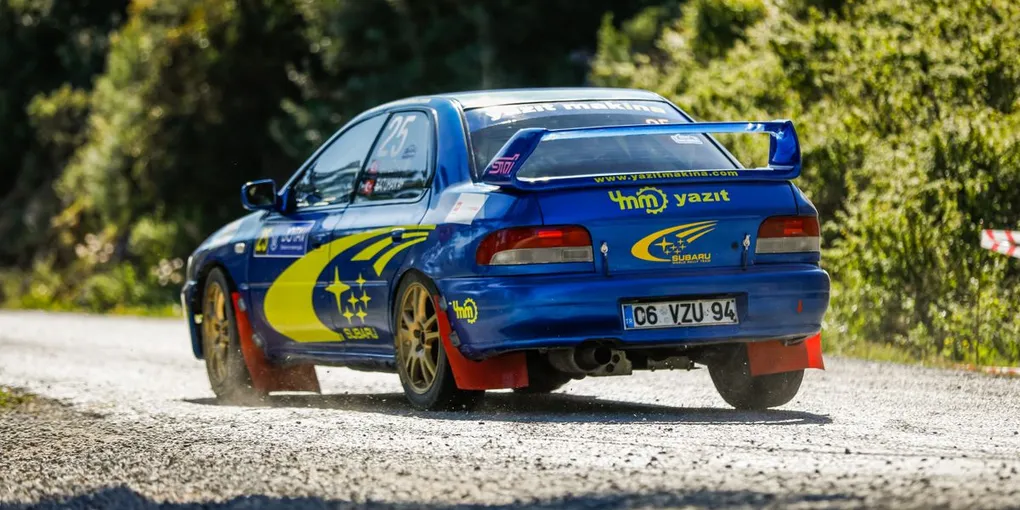
The Subaru WRX STI is the textbook example. Point it at a wet corner, mash the throttle, and the center diff sorts it out while the driver looks like a rally champion. You can get on the power earlier than any RWD car, and the car pulls itself through.
But there are catches. Several.
First: weight. AWD systems add 70-120 kilograms, most of it rotating mass. That’s felt in braking, turn-in, and fuel economy.
Second: understeer. Most AWD systems default to understeer at the limit because the front tires are sharing steering and power delivery — just like FWD. Only the most aggressive rear-biased systems (BMW M xDrive, Ferrari 4RM) let you play with the rear.
Third: tires. On an AWD car, all four tires must be nearly identical in circumference — Subaru specs no more than 1/4 inch difference. If one tire is more worn than the others, the center differential takes the strain. One puncture on a half-worn set often means replacing all four. That’s not a myth — Subaru specs it, and the center diff will protest if you ignore it.
The Honest Verdict
Daily driver, bad weather: AWD. No contest.
Pure driving feel, dry roads: RWD. Steering that talks to you, throttle-adjustable balance, no front axle interference. The GT86 and Miata prove that modest power with RWD is more fun than big power through the wrong wheels.
Budget + winter: FWD with real winter tires. A FWD car on Nokians will out-brake and out-corner an AWD car on all-seasons every time. Tires matter more than driven wheels.
Related: See how differentials work — the diff matters almost as much as which wheels are driven. And if you’re driving in winter, start with winter prep.