
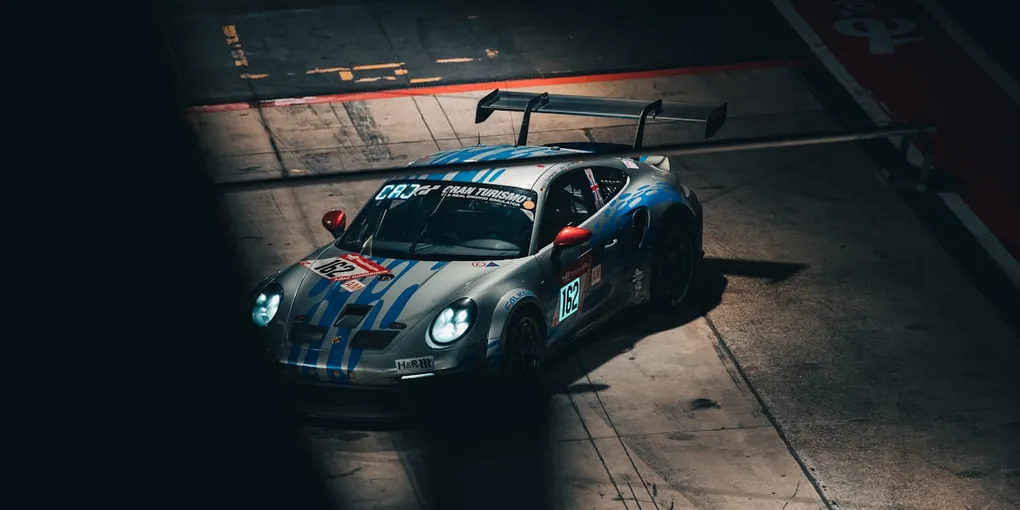

Walk through the paddock at the Nürburgring 24 Hours and you’ll see something unique: three completely different classes of race car sharing the same asphalt.
A half-million-euro Porsche 911 GT3 R with a factory driver. A privately owned Aston Martin Vantage GT4 driven by a dentist who funded his own seat. An Audi RS 3 LMS TCR — front-wheel-drive, four-door — muscling through the Karussell like it has a grudge against physics.
Same track. Same race. Wildly different machines.
The Quick Comparison
| GT3 | GT4 | TCR | |
|---|---|---|---|
| Cost (car only) | €450,000–550,000 | €180,000–220,000 | €130,000–150,000 |
| Power | 500–600 hp | 350–450 hp | 330–350 hp |
| Drivetrain | RWD | RWD | FWD |
| Aero | Massive downforce | Production-based, modest | Minimal |
| ABS / TC | No (driver aid-free) | Yes | Yes |
| Season budget | €2–5 million | €300,000–800,000 | €200,000–400,000 |
| Who drives | Factory pros, wealthy amateurs (Pro-Am) | Amateurs, gentleman drivers | Pros + amateurs, growing pro fields |
GT3: The Pinnacle
GT3 cars are the closest thing to a racing prototype you can buy as a customer. Based on production cars but radically modified — tube-frame interiors, carbon body panels, massive wings and diffusers, sequential gearboxes.
They drive like nothing else. The downforce alone is staggering — a GT3 car generates enough grip in high-speed corners that your neck muscles are the limiting factor, not the tires. No ABS. No traction control. You manage lock-ups and wheelspin with your feet, like the old days.
BoP — Balance of Performance — keeps the field close. Porsche, Ferrari, Lamborghini, Mercedes-AMG, BMW, Aston Martin, McLaren, Bentley, Audi, and more all race together. The organizers adjust ballast and power to equalize the cars. It’s controversial (every team thinks they’re getting screwed), but it works: GT3 grids are the most diverse and competitive in motorsport.
GT World Challenge, IMSA GTD/GTD Pro, DTM, Intercontinental GT Challenge — GT3 is the global standard. It’s also where the money is. Factory efforts from Porsche and Mercedes spend Formula-level budgets.
GT4: The Amateur’s GT3
GT4 is GT3’s sensible younger sibling. The cars look similar but are much closer to production spec. Less aero. Less power. Less everything — except accessibility.
The key difference is that GT4 cars keep their production ABS and traction control. This matters enormously for amateur drivers. A GT3 car will lock a tire and flat-spot a €3,000 set of rubber in one mistake. A GT4 car’s ABS prevents that. A GT3 car will spin if you’re too aggressive on corner exit. A GT4 car’s TC catches it.
This makes GT4 the sweet spot for gentleman drivers who want real racing without the terrifying consequences of GT3. A good amateur can be competitive in GT4. In GT3, the gap between a pro and an amateur is measured in seconds per lap, not tenths.
Series include GT4 European Series, IMSA Michelin Pilot Challenge, and support races at major GT3 events. It’s also where many young drivers get their first GT experience before stepping up.
TCR: The Underdog
TCR started in 2014 as an attempt to make touring car racing affordable and global. The formula: front-wheel-drive, production-based four/five-door cars, 2.0-liter turbo engines making ~350 hp, spec ECU (Magneti Marelli), and cost caps on components.
It worked. There are now 30+ TCR series worldwide. WTCR (World Touring Car Cup) is the pinnacle, but national series exist everywhere.
Driving a TCR car is a different skill. FWD means you manage understeer and use trail braking to rotate the car — very different from the throttle-steer technique you use in a GT3 or GT4. The racing is famously close because the performance window is narrower. Cars run nose-to-tail, bumpers touching, for entire races.
TCR is also the cheapest way into professional-level circuit racing. A full TCR season costs less than the GT3 car alone.
Where They Meet
The 24H Series and Nürburgring 24H run all classes together. Watching a GT3 driver navigate through TCR traffic at 2 AM in fog is one of motorsport’s great spectacles. IMSA’s Michelin Pilot Challenge pits GT4 against TCR directly — two completely different philosophies (RWD, high power vs FWD, momentum) fighting for the same piece of track.
Which One to Watch
Want to see the absolute fastest GT cars on Earth? GT3. The Nürburgring 24H and Spa 24 Hours are unmissable.
Interested in close amateur racing with real consequences for mistakes? GT4. The driving is relatable — these are people like us, just with bigger budgets.
Want door-to-door action where the driver matters more than the car? TCR. When the machinery is equalized, the racing comes down to skill.
The ladder makes sense: start in TCR or GT4, prove yourself, move to GT3. But plenty of drivers stay in GT4 or TCR their entire careers because, honestly, the racing is better.
Related: For a deep dive on GT3 specifically, read GT3 Racing Explained. And to understand the biggest race that brings all three classes together: Le Mans 24 Hours Guide.