

The GT86 is naturally aspirated. 200 horsepower from 2.0 liters, no turbo, no supercharger — just a boxer breathing on its own. And owners get asked constantly: “When are you going to boost it?”
It’s the right question, actually. Because the answer reveals exactly what each induction type trades away.
NA: The Dying Breed
Naturally aspirated engines are mechanically honest. The piston goes down, creates a vacuum, atmosphere rushes in. That’s it. No compressor, no lag, no complexity.
| Naturally Aspirated | |
|---|---|
| Throttle response | Instant. The pedal is a direct cable to the throttle plate |
| Power delivery | Linear — builds with RPM, peaks near redline |
| Sound | Clean. No turbo muffling the exhaust note |
| Efficiency | Lower specific output — need displacement for power |
| Reliability | Simplest. Fewest failure points |
| Example | GT86, GT3 RS, Huracán |
The GT86 makes 100 hp/liter — respectable for NA, laughable next to a turbo four making 150 hp/liter. But here’s what the spec sheet doesn’t tell you: when you blip the throttle on a downshift, the response is instant. No waiting for a compressor to spool. The tach needle jumps right now.
That matters on a winding road where you’re on and off the throttle constantly. Every hesitation between your foot and the engine is lost confidence. NA engines give you that confidence. The trade is you have to work for the power — the GT86’s boxer makes peak torque at 6,400 RPM, and around town that means downshifting when a turbo car would just ride the torque wave.
Turbo: The Modern Default
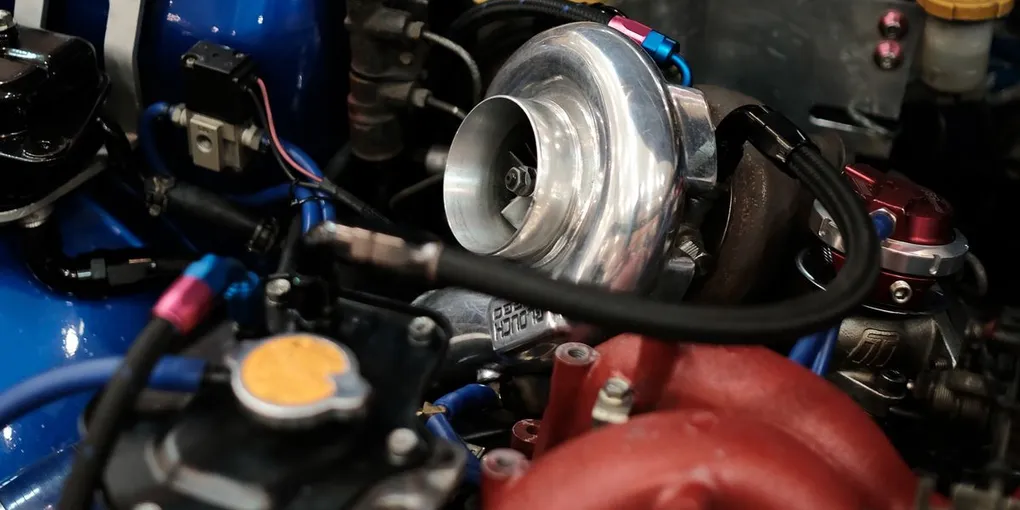
A turbocharger uses exhaust gas to spin a compressor that forces air into the engine. Waste energy becomes boost. It’s thermodynamically brilliant.
| Turbocharged | |
|---|---|
| Throttle response | Lag, then surge. Modern turbos are much better |
| Power delivery | Torque plateau from ~2,000 RPM — then pulls to redline |
| Sound | Muffled. Turbo acts as a silencer in the exhaust stream |
| Efficiency | Excellent at cruise (off boost), strong specific output |
| Reliability | Good if maintained. Oil quality is critical |
| Example | Golf R, M3/M4, 911 Turbo |
The modern turbo engine is a marvel. Twin-scroll housings, variable geometry vanes, electronic wastegates — the lag that defined 1990s turbos is largely gone. BMW’s B58 makes peak torque under 2,000 RPM and pulls clean to 7,000. It feels almost NA in response.
But “almost” is doing a lot of work. There’s still a moment between your foot and the boost. On track, that moment matters. In daily driving, you’ll never notice.
The real cost of turbos is heat. Everything runs hotter. Oil temperatures climb faster. Intercoolers heat-soak. For track use, budget for an oil cooler and pay attention to cooldown laps. Turbos spin at 150,000+ RPM on a film of oil thinner than a human hair. Let it coke up from heat and the turbo dies expensively.
Supercharged: The Theater Kid
A supercharger is belt-driven off the crankshaft. Step on the gas, boost arrives now — mechanically linked, no waiting.
| Supercharged | |
|---|---|
| Throttle response | Instant — boost mirrors RPM |
| Power delivery | Linear, enormous torque everywhere |
| Sound | That whine. Like a jet engine spooling up |
| Efficiency | Poor. Parasitic loss is real |
| Reliability | Robust when OEM. Aftermarket blowers stress everything |
| Example | Hellcat/Demon, Camaro ZL1, Jaguar F-Type R |
Superchargers split the difference: NA-like response with forced-induction power. The Hellcat’s 6.2-liter V8 makes 707+ hp with a Roots blower on top. It feels like a big-block from the 1960s that never runs out of breath.
The catch: spinning that blower consumes 50-100+ horsepower right off the crank. A Hellcat cruising at 70 mph is burning fuel to spin a compressor it doesn’t need at that moment. A turbo, off boost, isn’t. Superchargers also generate tremendous heat — air coming out of a Roots blower at full tilt can exceed 120°C before the intercooler. On a track, heat soak degrades performance lap after lap.
The Decision
If you want efficiency + top-end fury: turbo. Modern turbos are the best compromise for daily driving — efficient when cruising, fast when provoked.
If you want throttle response above all: NA. There’s a reason Porsche’s GT division still builds naturally aspirated engines. At 9,000 RPM in a GT3, nothing feels more alive.
If you want theater and immediacy: supercharger. That whine. The linear wall of torque. It’s not efficient, but efficiency isn’t the point.
The GT86 comes NA from the factory for a reason: the connection between pedal and engine is the car’s defining trait. Adding a turbo kit to make 300 hp is straightforward — the aftermarket supports it completely. But the instant response that makes the car rewarding on a back road is part of that trade. Boost changes the character. Whether that’s worth it depends on what kind of driving you actually do.
Related: For a deeper dive on the turbo vs supercharger debate, here’s that comparison. And if you’re wondering which fuel to feed your boosted engine: premium vs regular.