
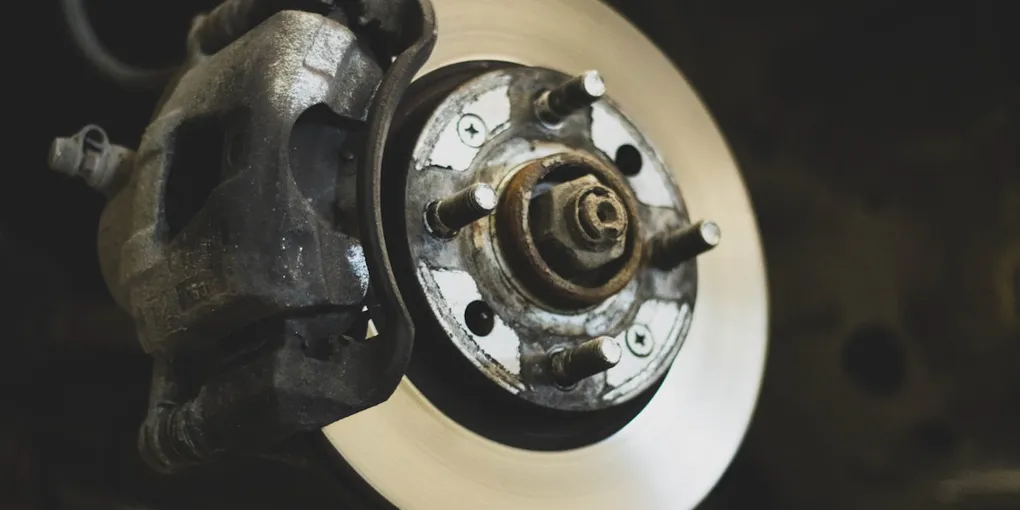

Carbon ceramic brakes. The yellow calipers. The option box that adds five figures to a Porsche configurator.
Here’s the most important thing to understand first: carbon ceramics do NOT stop your car in a shorter distance than steel brakes. The limit on braking distance is your tires, not your rotors. Any brake system powerful enough to engage ABS is powerful enough to use 100% of your tire grip.
So why does a 911 Turbo S with PCCB feel like it stops harder? And why would anyone spend $8,000–15,000 on the option? Let’s break it down.
The Physics: Why Stopping Distance Is a Tire Problem
Braking torque comes from the pad clamping the rotor. The rotor’s job is to absorb heat and dissipate it. That’s it.
Steel rotors do this just fine for one or two hard stops. Your tires lock up long before your steel rotors run out of grip. So on a single panic stop from highway speeds, steel and carbon ceramic are identical.
The difference appears when you do it again. And again. And again.
| Steel (Iron) | Carbon Ceramic | |
|---|---|---|
| Cold bite | Excellent | Poor to moderate — needs heat |
| Single-stop distance | Tire-limited | Tire-limited (same) |
| Repeated hard stops | Fade after 3–5 hard stops (stock pads) | Virtually fade-free |
| Rotor life (street) | 60,000–100,000 km | 200,000+ km (practically lifetime) |
| Rotor life (track) | 5–10 track days (depends on car weight) | 20–30 track days (if not overheated) |
| Pad cost | $100–350/set (street), $350–550 (track) | $600–1,200/set |
| Rotor replacement cost | $200–800/pair | $3,000–5,000/pair (each!) |
| Weight savings | — | ~5–6 kg per corner (unsprung + rotating) |
Where Carbon Ceramics Actually Win
Fade resistance. Steel rotors with stock pads will fade after 3-5 consecutive hard stops from high speed. The pad material overheats and outgasses, creating a gas layer between pad and rotor. Your pedal goes long, your braking distance grows. Carbon ceramics shrug this off. The ceramic matrix handles heat in a completely different way — no outgassing, no fade until temperatures that would melt a steel rotor.
On a light car like the GT86, this barely matters. At ~1,250 kg with a good set of pads, you can run 20-minute track sessions without fade. The weight simply doesn’t overwhelm the brakes.
On a heavy car — M5, Panamera Turbo, any EV — the equation changes. A stock-brake M3 will fade into Turn 1 at the Nürburgring after a few hard laps. That’s where carbon ceramics earn their keep.
Unsprung weight. Carbon ceramic rotors are roughly half the weight of equivalent steel rotors, saving 5-6 kg per corner in unsprung, rotating mass.
You’ll feel this. The car rides better over bumps. The steering is lighter and more precise. It’s subtle, but it’s there.
Dust and longevity on the street. Carbon ceramic pads produce almost no visible brake dust. Wheels stay clean. On the street, the rotors themselves will outlast the car — 200,000 km or more is normal. Steel rotors need replacement every 60,000-100,000 km.
Where Carbon Ceramics Lose
Cold performance. The first stop on a cold morning, carbon ceramics feel wooden. The pedal is firm but there’s less initial bite. By the second or third stop, they wake up. On the street, this is annoying. On track, the out lap warms them up and you’re fine.
Replacement cost when you get it wrong. The dark secret of carbon ceramics on track: if you overheat them — really overheat them — the carbon fibers in the matrix oxidize. The surface turns white and powdery at the edges. The rotor is now junk. That’s $3,000-5,000 per rotor, gone in one session.
The way to kill a carbon ceramic rotor: run the wrong pads. Steel-rotor track pads use abrasive friction that literally eats the ceramic matrix. One session on aggressive steel pads can destroy a $5,000 rotor. You must run CC-compatible pads, which cost $600-1,200 per set.
Pad cost. A set of front track pads for the GT86’s steel brakes is $250-400. For a Porsche with PCCB, compatible pads are $800-1,200. Per axle. You’ll go through 2-3 sets in a track season.
When to Buy Which
Stay with steel if:
- Your car is under 1,500 kg — you probably don’t need the fade resistance
- You do fewer than 5 track days per year
- You’re budget-conscious — steel consumables are 1/3 the price
- You drive in cold climates — carbon ceramics feel terrible below freezing
Go carbon ceramic if:
- Your car is heavy and you track it hard
- You want lifetime street rotors and clean wheels
- The weight savings matter to you (~5–6 kg per corner)
- You can afford the pad premium and the replacement cost if something goes wrong
The smart play: Buy the car with steel brakes. Take the $10k you saved and buy a BBK (Big Brake Kit) — AP Racing or Brembo with steel rotors. You’ll get 90% of the fade resistance, replaceable iron rings at $300 each, and better pad selection. Track guys have been doing this for decades.
The even smarter play (for Porsche owners): If your car came with PCCB, the rotors alone are worth several thousand used — enough to fund a steel BBK conversion and have money left over for a track season.
The carbon ceramic option is a flex. The yellow calipers look incredible, and the dust-free wheels are genuinely nice to live with. But for actual performance per dollar, you’re better off with a well-engineered steel setup and good pads.
Related: See trail braking for how to actually use those brakes. And if you’re tracking, read about tire pressure management — tires stop the car, not rotors.