
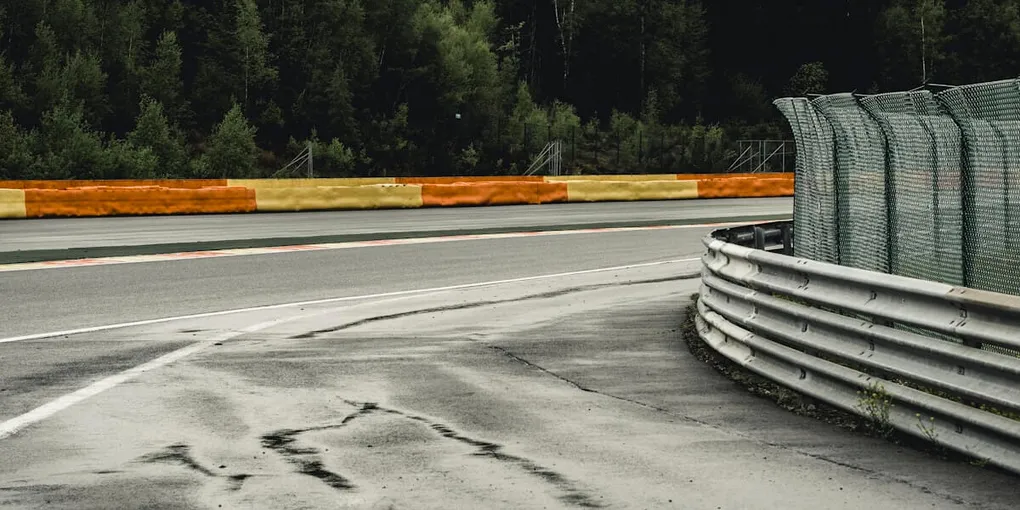

Every corner has an ideal path. Not the one your GPS suggests, and definitely not the one your friend in the passenger seat is yelling about. The racing line is mathematics disguised as intuition — a curve through a curve that maximizes exit speed, minimizes time, and turns a series of bends into one fluid motion.
The Goal: Maximize Exit Speed
Here’s the single most important principle in performance driving: the corner doesn’t end at the apex — it ends when you’re going straight again. A car accelerating from 50 mph to 100 mph gains more time than a car braking from 100 mph to 50 mph loses. Physics is asymmetric that way.
So the racing line isn’t about carrying the most speed into a corner. It’s about carrying the most speed out. Every decision — where you brake, where you turn in, where you clip the apex — serves this one objective.
The Three Phases of a Corner
1. The Entry (Outside → Inside)
You approach from the outside edge of the track. This straightens the corner as much as possible, giving you the largest radius — and larger radius = higher possible speed. You brake in a straight line (or with trail braking, as we’ve covered), then turn in decisively toward the apex.
2. The Apex (Inside Point)
The apex is the point where the car comes closest to the inside of the corner. There are three flavors:
- Early apex: You turn in early and clip the inside early. The car runs wide on exit. This is the slowest line — you’ve used up your turning before the corner is over, so you have to wait to get back on the gas. Only use this if there’s a straight immediately after and you’re prioritizing corner-entry drama.
- Geometric apex: The mathematical midpoint of the inside curb. Clean, symmetrical, and usually the right answer for long, constant-radius corners.
- Late apex: You delay turn-in, clip the inside later, and the car naturally tracks out to the outside edge on exit. This lets you get on the throttle earlier and harder. Late apex is generally the fastest line because it prioritizes exit speed.
3. The Exit (Inside → Outside)
After the apex, you unwind the steering and feed in throttle simultaneously. The car naturally drifts to the outside edge of the track — this is the “track out” point. If you’re not using the full width of the track on exit, you either turned in too early or you’re not carrying enough speed.
Stringing Corners Together
Real tracks and roads aren’t isolated corners. They’re sequences. The racing line through one corner changes if the next corner is a tight left-hander versus a long straight. This is called compromising the line — you sacrifice the ideal line through one corner to set up for the next one.
Example: a right-hand corner followed immediately by a left. If you take the classic late-apex line through the right-hander, you’ll track out to the left edge — which is exactly where you need to be to enter the following left. That’s not a coincidence. That’s reading the road.
Common Mistakes
- Turning in too early: The most common error. It feels fast because you’re carrying more entry speed, but you’re killing your exit. Patience on entry rewards you everywhere else.
- Not using the full track width: If there’s a foot of pavement you’re not using on entry or exit, you’re leaving speed on the table.
- Coasting: The gap between braking and accelerating should be as close to zero as possible. Every moment spent coasting is a moment you could be braking later or accelerating sooner. If you find yourself waiting mid-corner for the car to rotate before getting on the gas, your entry was too fast or your line was too shallow.
- Treating the throttle like a switch: Smooth, progressive throttle application keeps the chassis settled and the rear tires from breaking loose.
How to Practice on the Street
You don’t need a racetrack to understand the racing line — you need a clear road and discipline.
- Stay in your lane. The racing line principles apply within legal boundaries. Outside-inside-outside works just fine within lane markings.
- Look through the corner. Your car goes where your eyes go. Look at the exit, not the apex.
- Feel the weight transfer. As you turn in, can you feel the car take a set? Can you feel the moment the outside tires are fully loaded and ready for throttle?
Related: The racing line is about corner entry and exit — trail braking is how you rotate the car between them. For the full cornering picture, see heel-toe downshifting to nail your downshifts before turn-in.
The Bottom Line
The racing line isn’t a secret known only to F1 drivers. It’s a skill, and like any skill, it can be learned. Smooth inputs. Late apex. Early throttle. Full track width. Master these four things and you’ll be faster than 90% of the people at your next track day — without adding a single horsepower.