
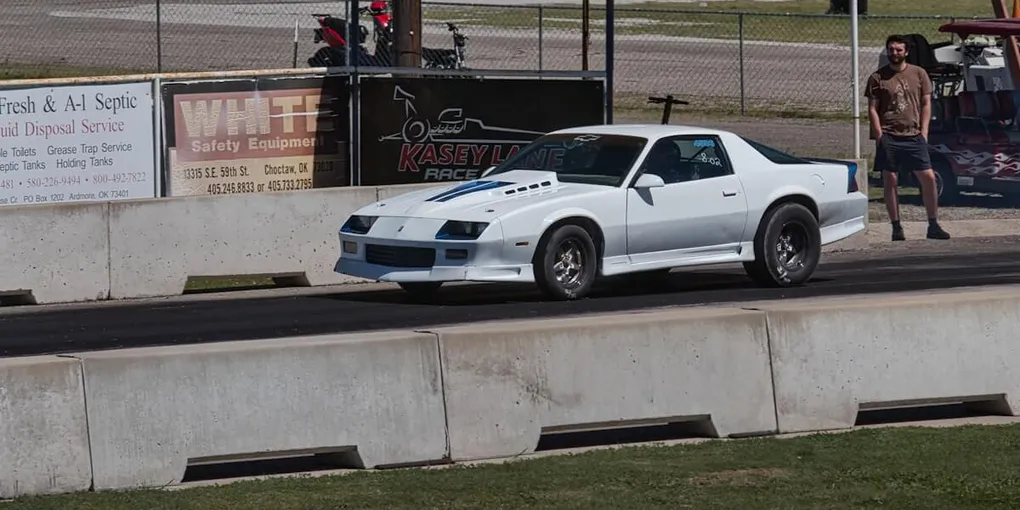

Every driver understands drag racing. Maybe you’ve never been to a strip, but you’ve sat at a red light next to someone who wanted to go. That instinct — who gets there first — is the foundation of the most accessible motorsport on Earth.
The Basics
A drag race is simple: two cars line up, the Christmas tree lights count down, and the first one to the finish line wins. The standard distance is a quarter-mile (1,320 feet), though many local tracks run eighth-mile for safety with faster cars.
The “Christmas tree” has three amber lights that illuminate in sequence, then a green. Leave before the green and you “red light” — automatic disqualification. Your reaction time (from green to movement) is part of your elapsed time. A perfect reaction time in a full tree is 0.500 seconds; in a Pro tree (all three ambers flash simultaneously), it’s 0.400. The best drivers react within 0.020-0.050 seconds of the green. Below 0.000 and you’ve red-lit.
The surface matters enormously. A prepped drag strip is not asphalt — it’s a specially treated surface coated with traction compound (PJ1 TrackBite or similar). The starting line is sprayed and dragged to create a surface so sticky that walking on it in sneakers feels like stepping on tape. This is why drag cars can launch with forces exceeding 5 G’s without spinning. On untreated asphalt, that same launch would roast the tires at half throttle.
The Classes
Drag racing spans everything from 17-second Honda Civics to 11,000-horsepower Top Fuel dragsters:
- Bracket Racing — The great equalizer. You predict your time (“dial-in”) and the slower car gets a head start equal to the difference. Breaks out (runs faster than your dial-in) and you lose. This is where anyone with a road-legal car can compete. You don’t need to be fast. You need to be consistent. A driver in a 17-second Civic who can run 17.20 every single pass will beat a driver in a 12-second Mustang who runs anywhere from 11.80 to 12.60. Bracket racing rewards predictability, not speed.
- Sportsman Classes — Stock, Super Stock, Competition Eliminator. Production-based cars with escalating levels of modification.
- Pro Stock — Tube-chassis, naturally aspirated V8s, 500ci, carbureted. 6.5 seconds at 210+ mph.
- Nitro Classes — Top Fuel and Funny Car. The pinnacle. 11,000 hp from 500 cubic inches. 0-100 mph in 0.8 seconds. 0-330 mph in 1,000 feet. The noise is physically painful. You feel it in your chest before you hear it.
Top Fuel and Funny Car engines share the same basic architecture — a 500ci V8 with a massive roots-style supercharger — but differ in wheelbase and body. Funny Cars have a shorter wheelbase and a one-piece fiberglass body that tilts up to reveal the chassis. Top Fuel dragsters are long, low, and the driver sits behind the rear axle. Both classes run on 90% nitromethane, a fuel that carries its own oxygen and can combust without atmospheric air. A Top Fuel engine at full throttle consumes fuel and air at a rate that would drain a swimming pool in minutes — the supercharger alone takes over 600 horsepower just to turn.
The Numbers That Break Your Brain
A Top Fuel dragster at full throttle:
- Consumes 1.2 gallons of nitromethane per second
- Exhaust temperature exceeds 3,000°F — hot enough to melt aluminum
- Pulls over 5 G’s at launch — more than a space shuttle
- Makes more horsepower than the first 8 rows of the Daytona 500 combined
- The engine is rebuilt between every run. Every. Single. Run.
- Spark plugs are consumed — the electrodes melt. The engine runs on compression ignition for most of the pass, like a diesel. The plugs are only there to get it started.
- At full throttle, the crankshaft twists up to 10 degrees, and the block itself distorts visibly under the cylinder pressures.
The shutdown is as dramatic as the launch. After crossing the finish at over 330 mph, the driver deploys two parachutes and applies the brakes. The negative G’s can exceed 6 — more force slowing down than the astronauts experienced launching on the Space Shuttle. The entire run, from the burnout to the parachute deployment, takes less than four seconds at the top level — and the engine will never run again without a complete teardown and rebuild. The clutch is replaced after every run too. Nothing on a Top Fuel car is designed to last longer than a single pass down the strip except the chassis itself, and even that has a finite fatigue life measured in hundreds of runs.
Drag racing is the most honest form of motorsport. There is no judging panel, no strategy, no tire management over a stint. Two cars line up, the tree counts down, and 1,320 feet later, one of them has won. Every variable — horsepower, traction, reaction time, shift speed — collapses into a single number on the timing board. It is the closest thing motorsport has to a physics equation, and the answer is always final.
Related: The engine in a Top Fuel dragster is the ultimate expression of forced induction. For a completely different kind of speed, see time attack racing.