

You have seen the terms a thousand times. Forged pistons. Cast aluminum intake manifold. Forged crankshaft. Cast wheels. But what does any of it actually mean — and when does it matter?
The Manufacturing Difference
Casting pours molten metal into a mold. It cools, solidifies, and you have your part. Cheap, fast, works for complex shapes. The problem: as the metal cools, its crystal structure forms randomly — grains nucleate at the mold walls and grow inward, meeting in the middle. There can be porosity (tiny air bubbles trapped during solidification), inclusions (impurities that didn’t melt out), and inconsistent grain structure. All of these are stress risers — points where cracks will initiate under cyclic loading.
Forging takes a solid chunk of metal and beats it into shape under extreme pressure — usually while hot, sometimes at thousands of tons of force. The hammering aligns the metal’s grain structure along the contours of the part, like wood grain following a branch. The grains stretch and flow around corners, through transitions, following the geometry of the finished piece. No porosity. No random crystal orientation. Just continuous grain flow that follows the loads the part will experience.
Imagine bending a piece of wood with the grain versus against it. With the grain, it flexes and recovers. Against the grain, it snaps. Forged metal behaves the same way — the directional grain structure resists fatigue cracks because cracks have to travel across grain boundaries, not along them. A crack in a cast part can follow a random grain boundary straight through the cross-section. The same crack in a forged part hits aligned grain boundaries that run perpendicular to the stress path.
Why It Matters
A forged connecting rod can handle the same peak cylinder pressure as a cast rod while weighing less — or handle more pressure at the same weight. The aligned grain structure means cracks don’t propagate as easily. Fatigue life — how many cycles the part survives before failing — can be 2-3x higher in a forged part versus an equivalent cast part.
This is why every serious engine build uses forged internals: pistons, rods, crankshaft. The rotating assembly is under constant, reversing loads at frequencies that would make your head spin. At 7,000 rpm, a connecting rod changes direction 233 times per second. Every reversal is a stress cycle — the rod stretches on the exhaust stroke as the piston is yanked to a stop at top dead center, then compresses on the power stroke as cylinder pressure forces it down. After 10 million cycles, the fatigue damage in a cast rod might be enough to initiate a crack. A forged rod at 10 million cycles is still within its fatigue limit — if it’s designed correctly, it will effectively never fail from fatigue alone.
Connecting rod failure is one of the most catastrophic engine failures possible. When a rod breaks at high RPM, it often exits through the side of the engine block, taking the piston, cylinder wall, and sometimes the crankshaft with it. The term for this is “ventilating the block,” and it is as expensive as it sounds. The cost difference between a set of forged rods and a set of cast rods — typically $400-600 — is about 5% of the cost of replacing an entire engine.
When Casting Wins
Casting isn’t inherently bad. It’s the right choice for:
- Complex shapes that would be impossible to forge — cylinder heads with intricate water jackets and port geometries, intake manifolds, and most engine blocks. The casting process can produce internal passages that no forging press could create.
- Large parts where the forging press would need to be the size of a building. A cast engine block is poured into a sand mold the size of a bathtub. Forging an equivalent block would require a press that doesn’t exist.
- Low-stress applications where the cost-to-benefit ratio of forging doesn’t pencil out — oil pans, valve covers, accessory brackets. These parts see static loads or low-cycle fatigue. Forged would be stronger, but cast is strong enough, and the money is better spent elsewhere.
Modern casting techniques have dramatically narrowed the quality gap. Investment casting (lost-wax) produces parts with surface finishes and dimensional accuracy approaching forging. Pressure casting forces metal into the mold under pressure, reducing porosity. Squeeze casting combines aspects of forging and casting to produce parts with forged-like grain structure and cast-like complexity. A well-designed, well-manufactured cast part in a modern engine is perfectly adequate for its intended load.
The Aftermarket Reality
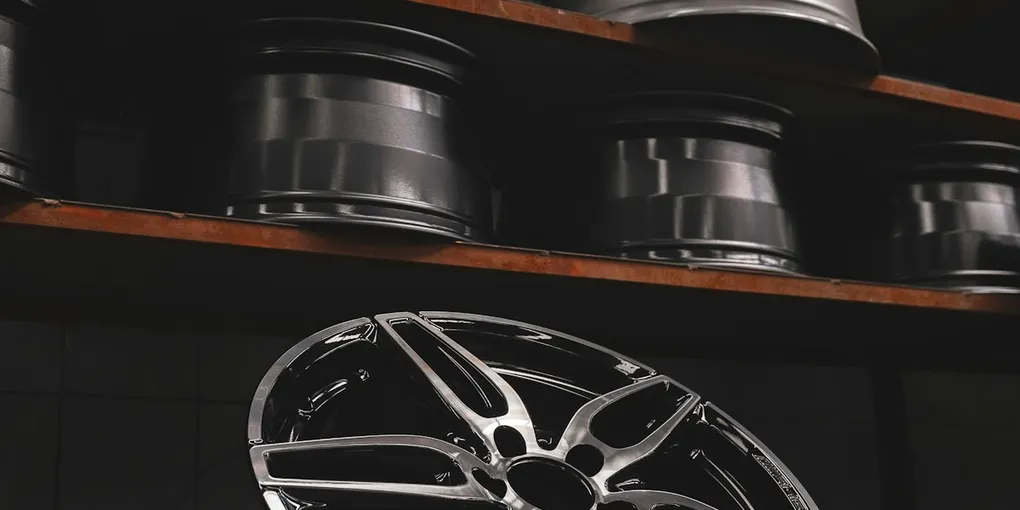
When you see “forged” on a spec sheet, ask what exactly is forged. A “forged” wheel might be just a forged center with a cast barrel — the part you see is forged, but the part that takes the impact loads is cast. “Forged internals” might mean forged pistons but cast rods — the pistons are strong, but the rods remain the weak link. Marketing departments exploit the ambiguity ruthlessly.
If your engine is internally stock and you never exceed the factory redline, factory cast internals are fine. The engineers who designed your engine specified cast components with safety factors appropriate for the stock power level. If you add boost, raise the redline, or increase cylinder pressure through tuning, the safety factor shrinks. If you go significantly beyond stock — more than 30% additional power, or a redline increase of more than 500 rpm — forged internals transition from “nice to have” to “cheap insurance against a ventilated block.”
Related: If you are building an engine, you are going to be protecting it under high stress. And the components are only as good as the tuning that controls how they are used.