

You want the car lower. The wheel gap is killing you.
There are three ways to get there, and they range from a $300 weekend job to a $5,000 full conversion. Each one rides differently, handles differently, and costs you something different. Lowering springs drop the car for cheap. Coilovers drop it properly. Air drops it on demand. Here’s what you’re actually buying.
Lowering Springs: The Cheap Drop
A lowering spring is exactly what it sounds like: a shorter, often stiffer spring that replaces your factory spring. You keep your stock shock absorbers and reuse everything else.
Cost: a set of four is roughly $200-400. Installation is an afternoon if you have a spring compressor and know what you’re doing, or a few hundred dollars at a shop.
The problem: your factory dampers were tuned for your factory springs. Drop the ride height an inch and you’re now asking stock shocks to control a stiffer, shorter spring they weren’t designed for. The result is often a bouncier ride and a damper that wears out faster.
Lowering springs make sense if you want the look on a budget and your car is new enough that the shocks are still fresh. They make less sense if you’re chasing real handling.
Coilovers: The Proper Solution
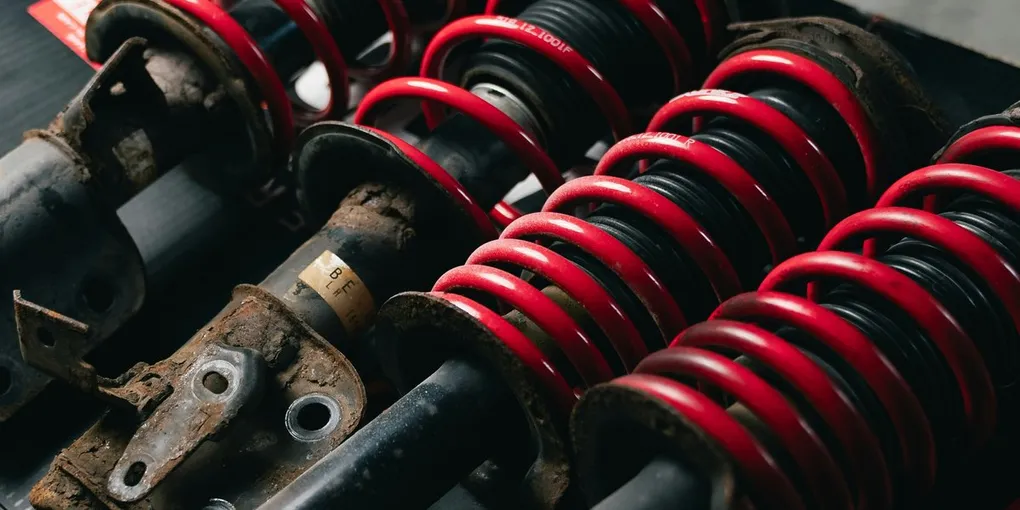
A coilover bundles the spring and the damper into one adjustable unit, built as a matched pair. The name comes from “coil spring over shock absorber.”
Two things set coilovers apart. First, they’re matched: the damper is valved for the spring it comes with, so the ride and handling work together. Second, they’re height-adjustable: the threaded body lets you raise or lower the car to where you want it.
Damping adjustment is a separate feature, and it’s not on every set. Budget coilovers are height-adjustable only, with fixed valving. Step up and you get rebound adjustment (and, higher still, compression), so you can soften them for the street and firm them up for track days.
Cost: a decent set of street coilovers runs $800-1,500. Track-capable ones push $2,000-3,000. The cheap ones exist, but cheap coilovers ride worse than good lowering springs: you’re paying for the damping, not the threaded collar.
The tradeoff: coilovers are firmer than stock. That’s the point, but on a daily driver it means you’ll feel every expansion joint. And once they’re on, adjusting ride height properly means re-aligning the car.
Air Suspension: The On-Demand Drop
Air suspension replaces the spring entirely with an air bag: a reinforced rubber bladder you inflate or deflate with an onboard compressor.
The appeal is obvious: press a button and the car sits on the ground for a photo. Press another and it lifts back up to clear a driveway or a speed bump. Air is the only option that gives you stance on demand and daily-driveability at the same time.
Cost: a full air setup (bags, struts, compressor, tank, and management) runs $2,500-5,000 installed. It’s the most expensive route by a wide margin.
The tradeoffs: air is heavier, it’s more complex (a leaking line or a dead compressor means the car is on its bump stops), and purists will tell you it doesn’t handle as sharply as a good coilover setup. That last part is debatable (modern performance air is better than it gets credit for), but the complexity is real.
The Comparison
| Lowering Springs | Coilovers | Air Suspension | |
|---|---|---|---|
| Cost (parts) | $200-400 | $800-3,000 | $2,500-5,000 |
| Height adjustable? | No, fixed drop | Yes, by hand | Yes, on the fly |
| Ride quality | Often bouncier | Firmer, controlled | Adjustable |
| Handling | Mostly cosmetic | Best | Good, slightly softer |
| Complexity | Low | Medium | High |
| Best for | Budget stance | Street / track | Stance + daily |
The Hidden Costs Everyone Ignores
Lowering a car is never just the suspension.
Alignment. Lower the car and your camber, toe, and caster all change. Without a proper alignment you’ll chew through tires. Budget for an alignment after any of these installs, and a second one if you change heights on coilovers.
Tire clearance. The lower you go, the more likely your tires rub on the fender liner or the arch. Rolling fenders, narrower tires, or more negative camber might be next on the list.
The ride home. A car dropped on its frame looks incredible in a photo and crashes over real roads. There’s a ride height where the look stops being worth it. You’ll find it.
Your dampers, with springs only. Lowering springs accelerate shock wear. If your shocks have 80,000 km on them, you’re buying new dampers soon anyway, which is the moment to consider coilovers instead.
The Takeaway
Lowering springs are for the look. Coilovers are for the driving. Air is for having both, at a price. Decide which one you actually want before you spend.
If you’re keeping the car long-term and want it to handle, buy the best coilovers you can afford. If you just want to close the wheel gap on a budget, springs get it done. And if you want to park it in the weeds and still make it over a speed bump, air is the only game in town.
Related: Once the car is lower, how to feel the car through g-forces will help you actually use the new setup. And before you touch anything, read car suspension explained for the theory behind the parts you’re replacing.