
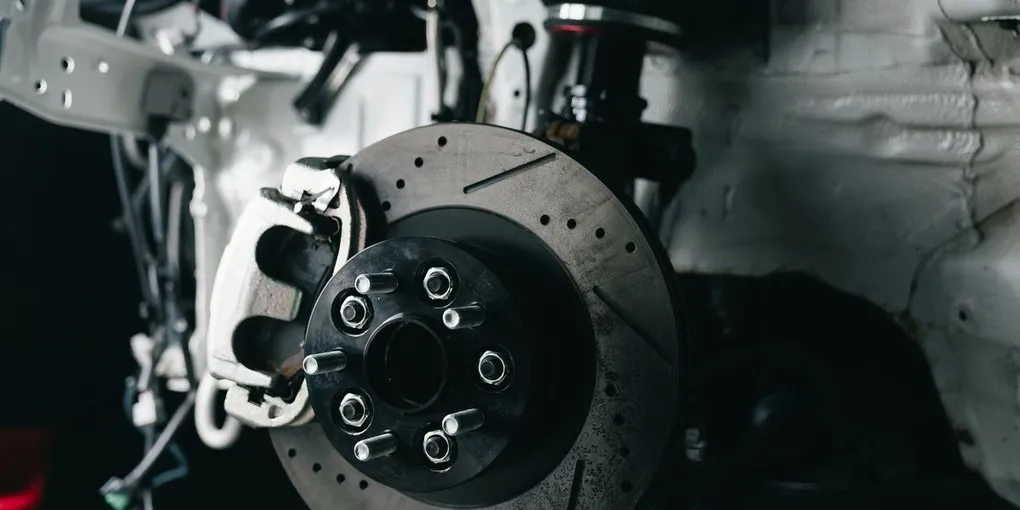

The rotor gets all the attention, but the brake pad is the part doing the actual work. It’s the thing that grips the spinning disc and turns your speed into heat.
And pads aren’t one-size-fits-all. A pad is tuned for a temperature, and street pads and track pads are tuned for completely different temperatures. Run the wrong one and you’re either not stopping, or not stopping safely.
What a Brake Pad Actually Does
When you press the pedal, the caliper squeezes the pads against the rotor. Friction between the pad material and the iron disc creates the force that slows the wheel, and, unavoidably, a lot of heat.
The pad is the sacrificial part. It’s designed to wear down so the rotor (which is expensive) wears down slowly.
The friction material is a recipe, not just “stuff.” It’s a blend of fibers, fillers, and binders baked into a block, and the recipe changes everything about how the pad behaves.
Street Pads: Built to Be Civilized
Street pads have one job: work perfectly, silently, and dust-free, from the first stop on a cold morning.
They’re engineered to bite hard when they’re cold, because a normal drive never gets them truly hot. They’re quiet, they don’t chew the rotor, and they don’t dust up your wheels.
There are three common street compounds:
Organic (NAO). Soft, quiet, low dust. Gentle on rotors. Fine for normal commuting, weak under repeated hard use.
Semi-metallic. Metal fibers mixed in for more bite and better heat tolerance. More dust and more noise, but better performance. The go-to for sporty street driving.
Ceramic. Fine ceramic fibers for low dust, low noise, and a stable pedal. Great daily-driver pad, decent heat tolerance, but not a track pad.
For a street car, any of these is fine. Pick for the driving you actually do: semi-metallic for enthusiastic driving, ceramic for a clean, quiet daily.
Track Pads: Built for Heat
A track pad is a different animal. It’s tuned to work at temperatures that would destroy a street pad: the kind of heat you build up braking from 200 km/h into a hairpin, lap after lap.
At those temperatures, a street pad’s friction material starts to break down. It outgasses, vaporizing its binders and forming a gas layer between the pad and rotor. The pedal goes long and the braking goes soft. That’s brake fade, and it’s a street pad’s way of telling you it’s out of its depth.
A track pad doesn’t fade where a street pad does, but it’s near-useless when it’s cold. Track compounds need heat before they bite. On a cold morning, a track pad has dramatically less initial grip than a street pad. The first stop can be genuinely scary.
They’re also noisy, they dust heavily, and they wear rotors aggressively: all tradeoffs that make sense at racing temperatures and make no sense on a commute.
Brake Fluid: The Other Half of Fade
Fade isn’t only the pad. The brake fluid can boil too.
Brake fluid is hygroscopic: it absorbs water over time, and that water lowers the fluid’s boiling point. When the fluid boils, it turns to gas, the gas compresses, and your pedal drops to the floor.
Fluid is rated by boiling point: DOT 4 boils higher than DOT 3, and DOT 5.1 higher still. For track use, fresh high-temp fluid is non-negotiable. For the street, fresh fluid of the right spec is a maintenance item most people ignore for years too long.
Change your brake fluid every couple of years regardless. It’s cheap insurance, and it’s the difference between a pedal that’s there and one that isn’t.
The Comparison
| Street Pad | Track Pad | |
|---|---|---|
| Works best | Cold to warm | Hot |
| Cold bite | Strong | Weak, needs heat |
| Fade resistance | Low to moderate | High |
| Noise | Quiet | Loud, squealy |
| Dust | Low to moderate | Heavy |
| Rotor wear | Gentle | Aggressive |
| On the street | Correct choice | Dangerous when cold |
| On track | Fades | Correct choice |
When to Upgrade
Street pads are right for you unless you’re actually tracking the car. For spirited back-road driving, a good semi-metallic or a mild “sport” compound is all you need, and it’ll still stop properly on the first cold stop of the morning.
You only need dedicated track pads when the car sees real track time. And even then, most people run track pads on track and swap back to street pads for the road. It’s a 30-minute job once you’ve done it a few times, and it keeps the right compound in the right environment.
The dangerous combination is the reverse: never run a cold-intolerant track pad on the street. The first emergency stop on a cold morning is exactly when you need maximum bite, and exactly when a track pad has the least.
Related: For the rotor side of the same decision, read steel vs carbon ceramic brakes. And trail braking is the technique that puts real heat into your pads.